
Lesson 1.2: 1.1 What Is a Pattern?
- View
Chapter 1 · Lesson 2 of 8 · About 11 minutes
Learning objectives Extra Practice
- Recognise a pattern in numbers, shapes, or events and explain why it is a pattern rather than a coincidence.
- Describe, extend, and create number patterns such as triangular, square, cube, doubling, and Virahanka (Fibonacci‑style) numbers.
- Represent a pattern using dots, shapes, grids, tables, or charts.
- State the general rule of a pattern in your own words using both a term‑to‑term rule and a position‑to‑term rule.
- Apply the four‑step pattern‑thinking process (Observe, Identify, Predict, Verify) and relate it to computational thinking.
Getting started
Patterns are everywhere — from the tiles on a floor to the numbers inside Pascal's Triangle. In this lesson you will learn what makes a pattern a pattern, how to spot the hidden rule, and how to describe, extend, and create patterns using numbers, shapes, and grids. By the end you will be able to explain why a sequence is predictable and connect that skill to the way computers recognise patterns in data.
Lesson Extra Practice
What Is a Pattern?
A pattern is an arrangement of numbers, shapes, colours, or events that follows a rule. Because the rule is fixed, once you know it you can say with confidence what comes next. The key word is rule — a pattern is not merely something repeated; it is repeated or changed in a predictable way.
- Repeating patterns – a fixed group appears again and again (e.g., red‑blue‑red‑blue).
- Growing patterns – each term is larger than the previous one following a fixed rule (e.g., 2, 4, 6, 8).
- Shrinking patterns – each term becomes smaller according to a rule (e.g., 100, 90, 80, 70).
- Shape or visual patterns – the rule governs how a picture, tile, or arrangement changes from step to step.
| Family | Example | Rule description |
|---|---|---|
| Repeating | red, blue, red, blue, … | Alternate two colours |
| Growing | 2, 4, 6, 8, … | Add 2 each time |
| Shrinking | 100, 90, 80, 70, … | Subtract 10 each time |
| Shape/Visual | □, □□, □□□, … | Add one square to the right |
Terms, Rules, and the Number Grid
Every pattern has two parts that work together: the terms (the visible numbers or shapes) and the rule (the hidden logic linking one term to the next). Mathematicians spend much of their time uncovering the rule because once it is known the whole pattern becomes predictable.
A useful first habit is to look for structure using a grid. In a 10 × 10 grid of the first hundred counting numbers, shade every multiple of 3. Even though the shaded numbers are scattered across ten rows, they line up into clean diagonal stripes. This happens because each row is 10 numbers wide and 10 is not a multiple of 3, so the shading shifts one column left each new row.
- Write the first 20 counting numbers in a 5 × 4 grid.
- Shade every multiple of 4.
- Observe the direction of the stripes.
- Explain why the stripes run diagonally.
Extending a simple number pattern Extra Practice
Problem: Sequence: 3, 6, 9, 12, ___. What number comes next? State the rule you used.
Solution:
- Identify the difference between consecutive terms: 6‑3 = 3, 9‑6 = 3, 12‑9 = 3.
- Recognise the term‑to‑term rule: add 3 to the previous term.
- Apply the rule to the last known term: 12 + 3 = 15.
Answer: 15 (rule: add 3 each time)
Representing Patterns in Different Ways
A single pattern can be shown in many forms. Choosing the right representation often makes the rule easier to see and explain.
- Dots or counters arranged in triangles, squares, or other shapes.
- Geometric shapes that grow step by step (e.g., adding a layer of squares).
- Number grids with shading or colour coding.
- Tables that list term number and term value side by side.
- Simple charts or graphs plotting term number against term value.
| Representation | Description |
|---|---|
| Dots | Two dots, then four, then six, then eight arranged in rows |
| Shapes | A line of squares growing by two squares each step |
| Grid | Shade every second cell in a 1 × 10 row |
| Table | Term 1 → 2, Term 2 → 4, Term 3 → 6, Term 4 → 8 |
| Chart | Points (1,2), (2,4), (3,6), (4,8) on a coordinate plane |
The Four‑Step Pattern‑Thinking Process
Pattern thinking mirrors the way computers learn from data. The four steps give a reliable routine for any new pattern you meet.
- Observe – look carefully at the given terms or shapes; note colours, sizes, positions, and any regularities.
- Identify – propose a rule that connects each term to the next (term‑to‑term) or links the term number to its value (position‑to‑term).
- Predict – use the rule to write the next two or three terms, or to find the 10th term without listing all previous ones.
- Verify – check your prediction against the original pattern or extend the pattern further to see if the rule still holds.
Patterns in Real Life and a Hands‑On Activity
Patterns appear in nature, technology, and everyday routines. Recognising them helps us make predictions and design solutions.
- Sunflower seed spirals follow the Virahanka (Fibonacci) numbers.
- Traffic lights cycle in a repeating pattern of red, amber, green.
- Computer vision systems spot patterns in pixels to decide whether a photo shows a cat or a dog.
- Music uses repeating rhythmic patterns and growing melodic sequences.
Teacher–student conversation Extra Practice
Teacher: Let's try the four steps on the sequence 5, 10, 15, 20. What do you observe?
Student: Each number is 5 more than the one before it.
Teacher: Great observation. Can you state the term‑to‑term rule and then predict the 7th term?
Real-world connections Extra Practice
- Sunflower seed spirals follow the Virahanka (Fibonacci) numbers.
- Traffic lights cycle in a repeating pattern of red, amber, green.
- Computer vision systems spot patterns in pixels to decide whether a photo shows a cat or a dog.
- Music uses repeating rhythmic patterns and growing melodic sequences.
Build a Growing Square Pattern Extra Practice
- Use square tiles or draw squares on graph paper.
- Step 1: make a 1 × 1 square (1 tile).
- Step 2: add a border of tiles around it to make a 3 × 3 square (9 tiles total).
- Step 3: add another border to make a 5 × 5 square (25 tiles total).
- Record the total number of tiles after each step in a table.
- Identify the rule linking step number to total tiles (square numbers).
- Predict the total for step 4 and verify by building it.
Materials: Square tiles (or graph paper and coloured pencils), ruler, notebook.
Important points to remember Extra Practice
- A pattern has terms and a rule; the rule makes the pattern predictable.
- Patterns can be repeating, growing, shrinking, or visual.
- Grids reveal hidden structure (e.g., diagonal stripes for multiples).
- The same pattern can be shown with dots, shapes, grids, tables, or charts.
- The four‑step process — Observe, Identify, Predict, Verify — is used by mathematicians and AI systems alike.
Lesson summary Extra Practice
In this lesson you learned that a pattern is a rule‑governed arrangement of numbers, shapes, or events. You explored four families of patterns, practiced finding term‑to‑term and position‑to‑term rules, and used a 10 × 10 grid to see how multiples create diagonal stripes. You also discovered multiple ways to represent a pattern and applied the four‑step pattern‑thinking process, which mirrors how computers learn from data. Finally, you connected patterns to real‑world examples and built a growing square model to experience square numbers hands‑on.
Illustrations retained from the textbook From Your Textbook
Fig. 1.1: A 10×10 number grid with every multiple of 3 shaded, showing the diagonal striping this produces From Your Textbook
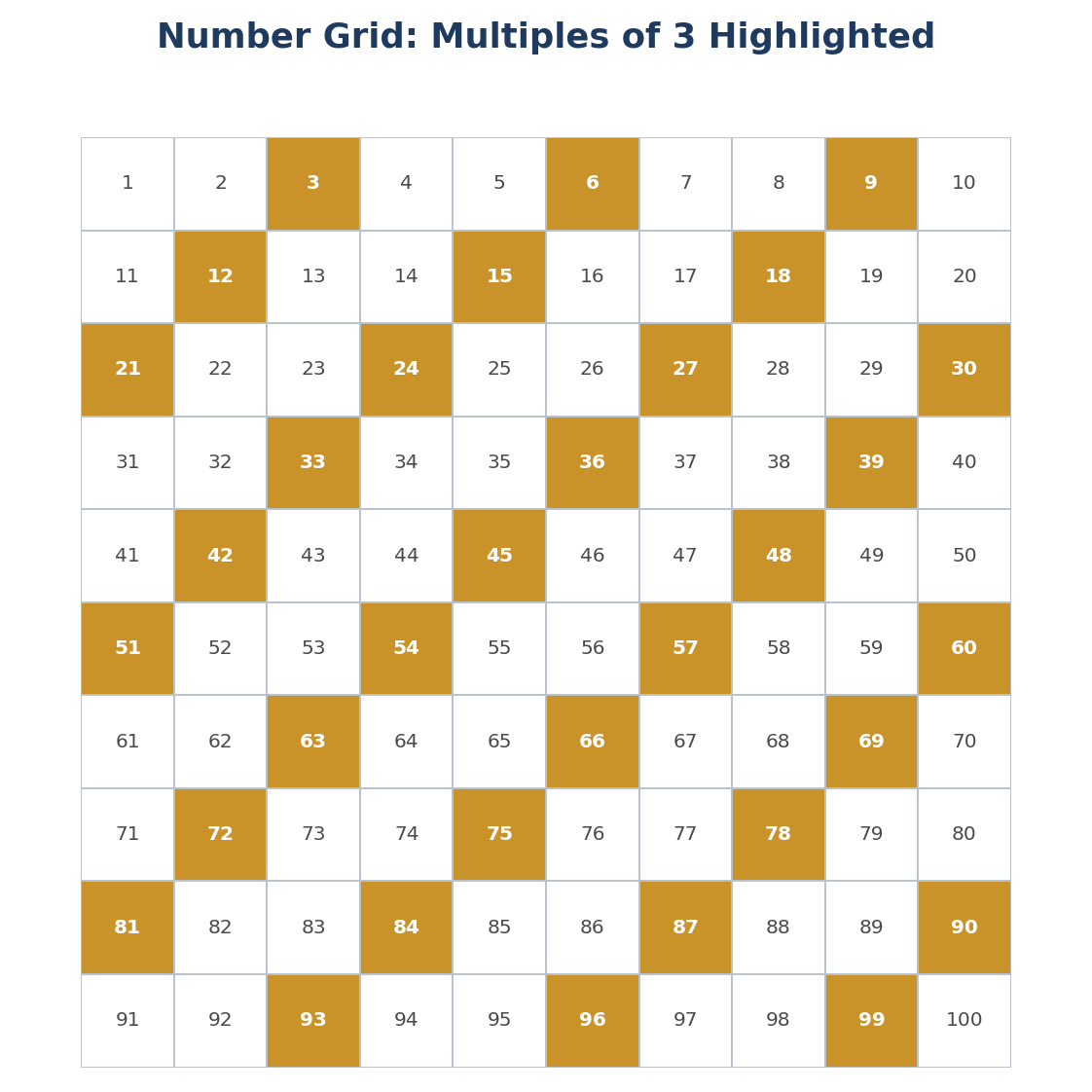
Square 10×10 grid, numbers 1 –100, gold-filled cells for multiples of 3, thin grey gridlines, bold white numerals on shaded cells
Teacher review note
The source text provides all definitions, examples, and the quick‑check sequence used in the lesson. No additional facts were invented.
AI-generated learning material based on the uploaded source. Please review explanations, examples and assessments before assigning this lesson to students.