
Lesson 1.3: 1.2 Patterns in Numbers (part 1)
- View
Chapter 1 · Lesson 3 of 8 · About 14 minutes
Learning objectives Extra Practice
- Recognise a pattern in a set of numbers and explain why it is a pattern rather than a coincidence.
- Describe, extend, and create number patterns such as skip‑counting, triangular numbers, square numbers, and the doubling pattern.
- Discover hidden connections between different number patterns, including the link between triangular and square numbers.
- Represent a pattern using dots, shapes, grids, tables, or a simple chart.
- State the general rule behind a pattern in your own words, using both a term‑to‑term rule and a position‑to‑term rule.
- Connect pattern recognition to computational thinking and to how machines learn to spot patterns in data.
Getting started
Patterns are everywhere — in the tiles on a floor, the petals of a flower, the numbers inside Pascal's Triangle, and even in the way a computer recognises a cat in a photograph. In this lesson we explore several classic number patterns that arise from simple counting and from arranging dots into shapes. We will learn how to describe each pattern with a term‑to‑term rule and a position‑to‑term rule, how to represent patterns visually, and how the same thinking process — Observe, Identify, Predict, Verify — underlies computational thinking and artificial intelligence.
Lesson Extra Practice
1. Counting Patterns and Skip‑Counting
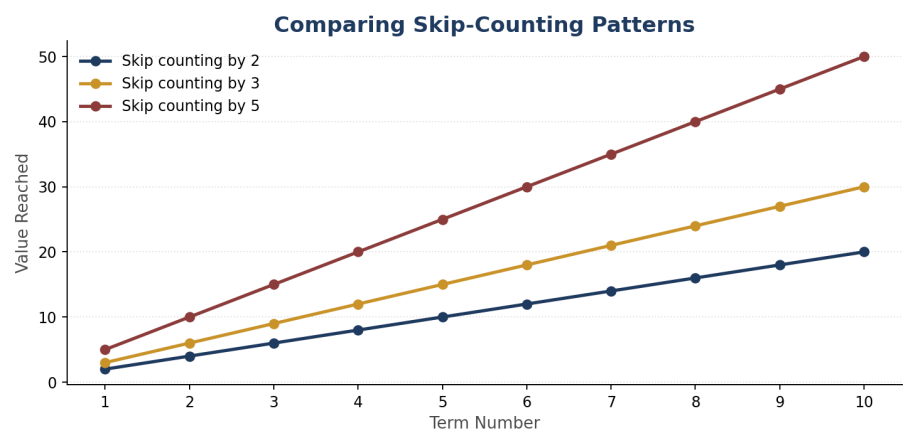
The simplest growing pattern is ordinary counting: 1, 2, 3, 4, 5 … A close relative is skip‑counting, where we add a fixed number other than 1 each time. Skip‑counting by 2 gives 2, 4, 6, 8, 10; by 3 gives 3, 6, 9, 12, 15; by 5 gives 5, 10, 15, 20, 25. These sequences are the foundation for multiplication tables, telling time in five‑minute steps, and counting money in coins of a fixed value.
- Step size = the number added each term.
- Larger step size → steeper growth when plotted.
- All skip‑counting patterns are arithmetic sequences with constant difference.
- Choose a step size (e.g., 4).
- Write the first term (usually the step size itself).
- Repeatedly add the step size to generate further terms.
- Plot the terms on a graph to see the steepness.
| Term | Skip‑count by 2 | Skip‑count by 3 | Skip‑count by 5 |
|---|---|---|---|
| 1 | 2 | 3 | 5 |
| 2 | 4 | 6 | 10 |
| 3 | 6 | 9 | 15 |
| 4 | 8 | 12 | 20 |
| 5 | 10 | 15 | 25 |
| 6 | 12 | 18 | 30 |
| 7 | 14 | 21 | 35 |
| 8 | 16 | 24 | 40 |
| 9 | 18 | 27 | 45 |
| 10 | 20 | 30 | 50 |
2. Triangular Numbers
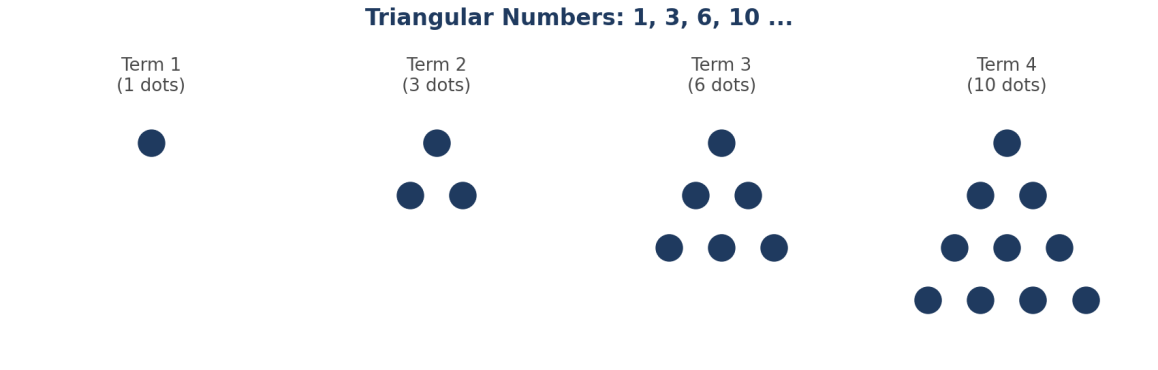
Triangular numbers appear when we stack dots so that each new row has one more dot than the row above it. The first term is a single dot. Adding a row of two dots gives 3 dots total; adding a row of three gives 6; then 10, 15, 21 … The sequence is 1, 3, 6, 10, 15, 21 …
- Term‑to‑term rule: add the next counting number (add 2, then 3, then 4, …).
- Position‑to‑term rule: the nth triangular number = n(n + 1) / 2.
- Visual: each term forms an equilateral triangle of dots.
- Draw a triangle of dots for term 1 (1 dot).
- For term 2, add a row of 2 dots below.
- Continue adding rows, each one dot longer than the previous.
- Count total dots to verify the sequence.
Finding the 7th triangular number Extra Practice
Problem: Use the position‑to‑term rule to find the 7th triangular number.
Solution:
- Identify n = 7.
- Apply formula: n(n + 1) / 2 = 7 × 8 / 2.
- Calculate 7 × 8 = 56.
- Divide 56 by 2 = 28.
Answer: The 7th triangular number is 28.
3. Square Numbers
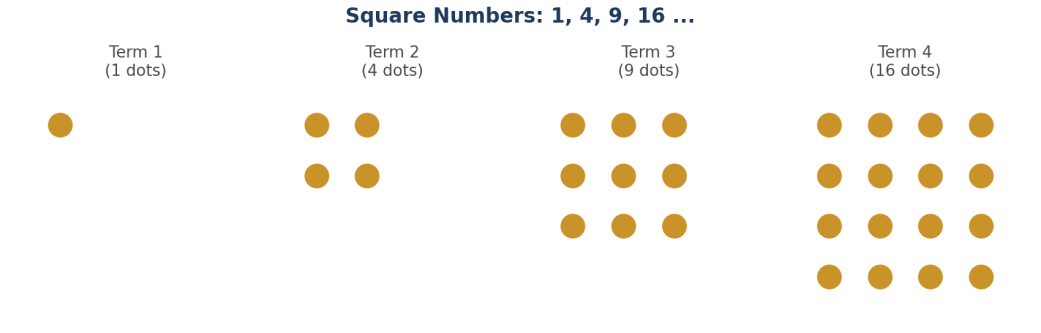
Square numbers arise from arranging dots into perfect squares: 1×1, 2×2, 3×3, … The sequence is 1, 4, 9, 16, 25 … Each term equals a counting number multiplied by itself (n²).
- Term‑to‑term rule: add the next odd number (1, 3, 5, 7, …).
- Position‑to‑term rule: the nth square number = n².
- Visual: each term forms a square grid of dots.
- Draw a 1×1 square (1 dot).
- To get the next square, add an L‑shaped layer (gnomon) of 3 dots around two sides.
- Continue adding gnomons of 5, 7, 9 … dots.
- Count total dots to confirm the square numbers.
| Square | Square value (n²) | Gnomon added (odd number) | Cumulative sum of odds |
|---|---|---|---|
| 1 | 1 | 1 | 1 |
| 2 | 4 | 3 | 1 + 3 = 4 |
| 3 | 9 | 5 | 1 + 3 + 5 = 9 |
| 4 | 16 | 7 | 1 + 3 + 5 + 7 = 16 |
| 5 | 25 | 9 | 1 + 3 + 5 + 7 + 9 = 25 |
4. Connections Between Patterns
Mathematicians love hidden links. Two consecutive triangular numbers always add to a square number: 1 + 3 = 4, 3 + 6 = 9, 6 + 10 = 16, 10 + 15 = 25. This happens because a square can be split into two triangles along a diagonal.
- Triangular + next triangular = square.
- Gnomons of squares are the odd numbers.
- Skip‑counting patterns are arithmetic sequences; triangular and square patterns are quadratic.
- List triangular numbers: 1, 3, 6, 10, 15 …
- Add each pair of neighbours: 1+3, 3+6, 6+10 …
- Observe the results: 4, 9, 16, 25 … (square numbers).
- Explain in words: a square of side n consists of two triangles of sides n and n‑1.
5. Representing Patterns
A pattern can be shown in many ways: as a list of numbers, a table of term versus value, a dot diagram, a bar chart, or a line graph. Choosing the right representation helps us see the rule and the growth rate.
- Dot diagrams – show shape (triangle, square).
- Tables – organise term number and value for easy rule‑finding.
- Graphs – reveal steepness (growth rate) and whether the pattern is linear or quadratic.
- Write the first five terms of a pattern in a two‑column table.
- Plot term number on the horizontal axis and value on the vertical axis.
- Draw a smooth curve through the points to see the shape of growth.
- Compare graphs of skip‑counting (straight lines) with triangular/square (curved).
6. Writing the Rule of a Pattern
A clear rule lets anyone — a classmate or a computer — extend the pattern without seeing every earlier term. We use two kinds of rules: term‑to‑term (how to get from one term to the next) and position‑to‑term (a formula that gives the nth term directly).
- Term‑to‑term rule for triangular numbers: “Add the next counting number.”
- Position‑to‑term rule for triangular numbers: Tₙ = n(n + 1)/2.
- Term‑to‑term rule for square numbers: “Add the next odd number.”
- Position‑to‑term rule for square numbers: Sₙ = n².
Writing rules for the doubling pattern Extra Practice
Problem: The doubling pattern starts 1, 2, 4, 8, 16 … Write both a term‑to‑term rule and a position‑to‑term rule.
Solution:
- Observe each term is twice the previous term.
- Term‑to‑term rule: “Multiply the previous term by 2.”
- Notice term 1 = 2⁰, term 2 = 2¹, term 3 = 2² …
- Position‑to‑term rule: the nth term = 2^(n‑1).
Answer: Term‑to‑term: multiply by 2. Position‑to‑term: aₙ = 2^(n‑1).
Teacher–student conversation Extra Practice
Teacher: Look at the triangular numbers we built with dots. What do you notice about the differences between consecutive terms?
Student: The differences are 2, 3, 4, 5 … they increase by 1 each time.
Teacher: Exactly. That increasing difference is the clue that the pattern is quadratic, not linear. Can you write the term‑to‑term rule in your own words?
Teacher: Now examine the square numbers and their gnomons. Why are the gnomons always odd numbers?
Student: Because each new L‑shaped layer adds two sides of the square plus the corner dot, which is 2n‑1 — an odd number.
Teacher: Well said. That odd‑number gnomon is why the sum of the first n odd numbers equals n².
Real-world connections Extra Practice
- Handshake problem: In a group of n people, total handshakes = triangular number Tₙ₋₁.
- Round‑robin tournament scheduling uses triangular numbers to count matches.
- Tiling a floor with square tiles relates to square numbers; the number of tiles in an n×n patch is n².
- Skip‑counting by 5 underlies reading analog clocks and counting money in 5‑cent coins.
- Doubling pattern appears in bacterial growth, computer memory sizes (1, 2, 4, 8, 16 GB), and binary code.
Dot‑Pattern Building Extra Practice
- Use counters or draw dots on grid paper.
- Build the first five triangular numbers and the first five square numbers.
- Record the total dots for each term in a table.
- Write the term‑to‑term rule and the position‑to‑term rule for each pattern.
Materials: Counters or beads, grid paper, pencils, ruler.
Skip‑Counting Chart Race Extra Practice
- In pairs, each student chooses a different step size (2, 3, 4, 5, 6).
- On a shared number line 0–60, mark the first ten terms of your skip‑counting pattern.
- Compare the steepness of the lines and discuss why larger steps reach higher numbers faster.
- Write a sentence describing the relationship between step size and growth rate.
Materials: Large paper number line 0–60, coloured markers.
Gnomon Puzzle Extra Practice
- Cut out L‑shaped paper pieces of sizes 1, 3, 5, 7, 9 squares.
- Start with a 1×1 square. Add gnomons one by one to form 2×2, 3×3, 4×4, 5×5 squares.
- Verify that the total number of unit squares after each addition matches the square numbers.
- Explain in writing why each gnomon has an odd number of squares.
Materials: Coloured cardstock, scissors, glue stick.
Important points to remember Extra Practice
- A pattern repeats or grows in a predictable way; it is not a coincidence.
- Skip‑counting patterns are arithmetic sequences with constant difference.
- Triangular numbers: Tₙ = n(n + 1)/2; term‑to‑term rule adds the next counting number.
- Square numbers: Sₙ = n²; term‑to‑term rule adds the next odd number (gnomon).
- Two consecutive triangular numbers sum to a square number.
- Patterns can be represented with dots, tables, graphs, or formulas.
- Writing both term‑to‑term and position‑to‑term rules makes a pattern reproducible by humans and computers.
- The four‑step process — Observe, Identify, Predict, Verify — is the core of computational thinking.
Lesson summary Extra Practice
In this lesson we explored several classic number patterns that arise from simple counting and from arranging dots into triangles and squares. We learned to describe each pattern with a term‑to‑term rule and a position‑to‑term rule, to represent patterns visually and in tables, and to discover hidden connections such as the fact that two consecutive triangular numbers always make a square. These skills — observing, identifying, predicting, and verifying — are the same steps used in computational thinking and in teaching machines to recognise patterns in data.
Illustrations retained from the textbook From Your Textbook
Fig. 1.3: The first four triangular numbers, built by adding one more row of dots each time From Your Textbook
Four-panel dot diagram, terms 1 –4, navy filled circles arranged in a stacked -row triangle, term label and dot-count caption above each panel
Fig. 1.4: The first four square numbers, formed as perfect square arrangements of dots From Your Textbook
Four-panel dot diagram, terms 1 –4, gold filled circles arranged in n×n grids, term label and dot -count caption above each panel
Fig. 1.5: Square numbers rebuilt layer by layer, where each new coloured L -shaped gnomon adds the next odd number of dots From Your Textbook
Four-panel dot diagram, terms 1 –4, each panel shows an n×n square coloured in n bands (one colour per gnomon layer: navy, gold, maroon, green), caption states dots added and running total
AI-generated learning material based on the uploaded source. Please review explanations, examples and assessments before assigning this lesson to students.