
Lesson 1.4: 1.2 Patterns in Numbers (part 2)
- View
Chapter 1 · Lesson 4 of 8 · About 14 minutes
Learning objectives Extra Practice
- Identify and extend cube numbers, the doubling pattern, and Virahanka numbers.
- Explain the term‑to‑term and position‑to‑term rules for each pattern.
- Represent patterns with dots, cubes, tables, or charts.
- Discover how Virahanka ratios approach the golden ratio.
- Connect pattern recognition to computational thinking and real‑world phenomena.
Getting started
In this lesson we explore three fascinating number patterns that grow in very different ways: cube numbers, the doubling pattern (powers of two), and the Virahanka (Fibonacci) numbers. By building models, calculating terms, and spotting connections, you will learn how to recognise a pattern, describe its rule, and predict future terms — skills that are at the heart of mathematical thinking and modern computing.
Lesson Extra Practice
1. Cube Numbers – Building Solid Blocks
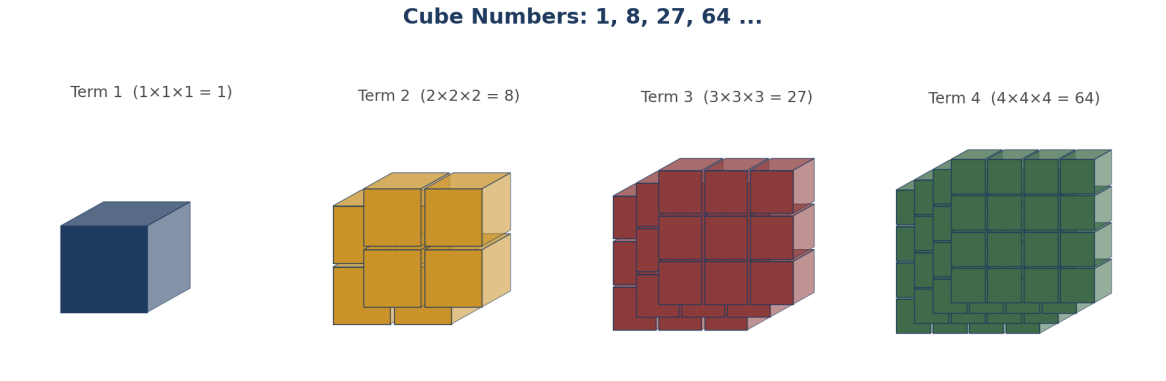
A cube number is the total number of unit cubes needed to build a larger cube that is n cubes long, n cubes wide, and n cubes tall. The first four cube numbers are 1, 8, 27, and 64.
- 1³ = 1 × 1 × 1 = 1
- 2³ = 2 × 2 × 2 = 8
- 3³ = 3 × 3 × 3 = 27
- 4³ = 4 × 4 × 4 = 64
- 5³ = 5 × 5 × 5 = 125
Because every new layer adds cubes in three directions at once, cube numbers grow much faster than square numbers.
- Choose a value for n (the side length).
- Multiply n by itself three times: n × n × n.
- The product is the nth cube number.
Finding the 6th Cube Number Extra Practice
Problem: What is the 6th cube number?
Solution:
- Identify n = 6.
- Calculate 6 × 6 × 6 = 216.
- The 6th cube number is 216.
Answer: 216
2. The Doubling Pattern – Powers of Two
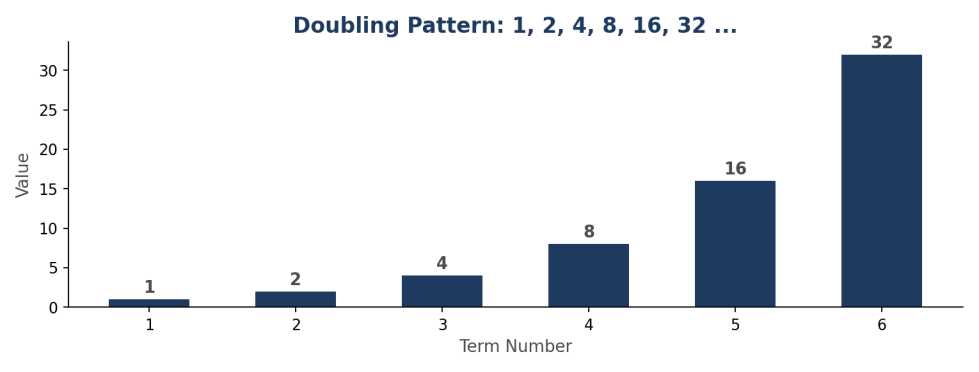
The doubling pattern starts at 1 and each term is twice the previous term. It is the sequence of powers of two: 1, 2, 4, 8, 16, 32, 64, …
- Term‑to‑term rule: multiply the previous term by 2.
- Position‑to‑term rule: the nth term = 2^(n‑1).
- Growth is slow at first, then extremely rapid.
| Position | Term (2^(n‑1)) |
|---|---|
| 1 | 1 |
| 2 | 2 |
| 3 | 4 |
| 4 | 8 |
| 5 | 16 |
| 6 | 32 |
| 7 | 64 |
| 8 | 128 |
A famous story tells of a king who agreed to place one grain of rice on the first square of a chessboard, two on the second, four on the third, and so on. By the 64th square the total exceeds all rice ever produced.
3. Virahanka Numbers and the Golden Ratio
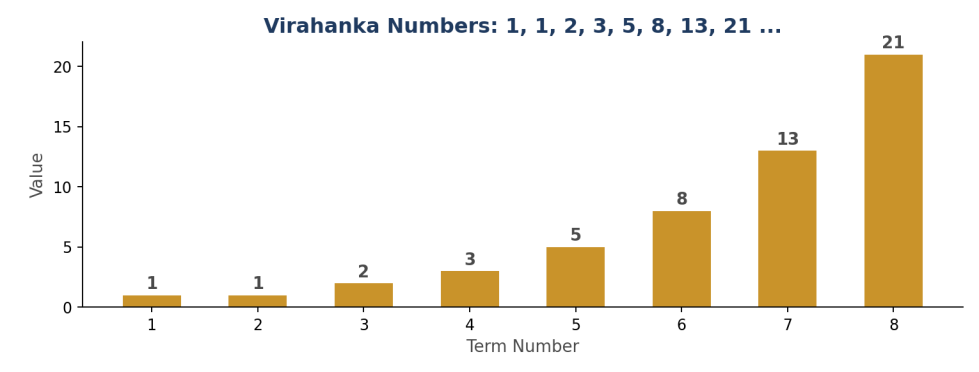
The Virahanka (Fibonacci) sequence begins 1, 1, 2, 3, 5, 8, 13, 21, … Each term is the sum of the two preceding terms. This pattern appears in flower petals, sunflower seed spirals, and nautilus shells.
- Term‑to‑term rule: add the two previous terms.
- Position‑to‑term rule: no simple closed form at this level; we generate terms step by step.
- Ratios of consecutive terms approach the golden ratio ≈ 1.618.
- Write the first two terms: 1, 1.
- Add them to get the third term: 1 + 1 = 2.
- Continue: 1 + 2 = 3, 2 + 3 = 5, 3 + 5 = 8, …
Approaching the Golden Ratio Extra Practice
Problem: Calculate the ratio of the 7th term to the 6th term in the Virahanka sequence.
Solution:
- List terms up to the 7th: 1, 1, 2, 3, 5, 8, 13.
- 6th term = 8, 7th term = 13.
- Divide 13 by 8 = 1.625.
Answer: 1.625 (close to 1.618)
4. Patterns, Rules, and Computational Thinking
Recognising a pattern means observing, identifying a rule, predicting the next terms, and verifying the prediction. This four‑step process — Observe, Identify, Predict, Verify — is exactly how computers learn to spot patterns in data, from recognising faces to recommending videos.
- Observe: look at a list of numbers or a visual model.
- Identify: state the term‑to‑term and position‑to‑term rules in your own words.
- Predict: use the rule to find the next three terms.
- Verify: check your prediction by building the model or recalculating.
When you can write a clear rule, a classmate — or a computer program — can continue the pattern without seeing every earlier term.
Teacher–student conversation Extra Practice
Teacher: Look at the cube numbers 1, 8, 27, 64. What do you notice about how they grow?
Student: Each one is a perfect cube: 1³, 2³, 3³, 4³. The jump from 27 to 64 is bigger than from 8 to 27.
Teacher: Exactly. Because we multiply three dimensions, the increase gets larger each step. Can you write the position‑to‑term rule?
Teacher: If we double a number five times starting from 1, what term do we reach?
Student: 1, 2, 4, 8, 16, 32 — the sixth term is 32.
Teacher: Good. That is 2^(6‑1). How would you explain the rule to a computer?
Teacher: Here are the first seven Virahanka numbers: 1, 1, 2, 3, 5, 8, 13. What is the next term?
Student: Add the last two: 8 + 13 = 21.
Teacher: Right. Now divide 21 by 13. What do you notice about the ratio?
Real-world connections Extra Practice
- Cube numbers model the volume of cubic containers (e.g., shipping boxes, water tanks).
- The doubling pattern explains viral spread, compound interest, and limits of paper folding.
- Virahanka numbers appear in plant growth, pinecone spirals, and the arrangement of leaves.
- Pattern‑recognition algorithms power search engines, recommendation systems, and medical imaging.
Build Cube Numbers with Sugar Cubes Extra Practice
- Gather 125 sugar cubes (or small blocks).
- Build a 1×1×1 cube, then a 2×2×2 cube, then a 3×3×3 cube.
- Count the cubes used for each model and record the numbers.
- Predict how many cubes a 4×4×4 cube needs, then build it to verify.
Materials: 125 sugar cubes or interlocking blocks, paper, pencil
Doubling Pattern Race Extra Practice
- In pairs, start with 1 on a sheet of paper.
- Each round, double the previous number and write it down.
- See how many rounds you can complete in 2 minutes.
- Discuss why the numbers become huge so quickly.
Materials: Paper, pencils, timer
Virahanka Spiral Drawing Extra Practice
- Draw squares with side lengths equal to Virahanka numbers: 1, 1, 2, 3, 5, 8 cm.
- Arrange them edge‑to‑edge to form a growing rectangle.
- Draw a quarter‑circle arc in each square to create a spiral.
- Observe how the spiral approximates the golden spiral.
Materials: Graph paper, ruler, compass, coloured pencils
Important points to remember Extra Practice
- Cube numbers = n³; they grow by multiplying three dimensions.
- Doubling pattern = powers of two; term‑to‑term rule: ×2, position‑to‑term rule: 2^(n‑1).
- Virahanka numbers: each term = sum of two previous terms; ratios approach the golden ratio ≈ 1.618.
- A clear rule (term‑to‑term and position‑to‑term) lets anyone or a computer extend the pattern.
- The four‑step pattern‑thinking process (Observe, Identify, Predict, Verify) underlies computational thinking.
Lesson summary Extra Practice
We explored three classic number patterns: cube numbers that fill three‑dimensional space, the doubling pattern that multiplies by two each step, and the Virahanka sequence that adds the two previous terms and leads to the golden ratio. By building models, calculating terms, and writing rules, you practiced the core skills of pattern recognition — observing, identifying, predicting, and verifying — which are essential for mathematics and for teaching computers to learn from data.
Illustrations retained from the textbook From Your Textbook
Fig. 1.6: The first four cube numbers, shown as isometric stacks of unit cubes: 1, 8, 27, and 64 From Your Textbook
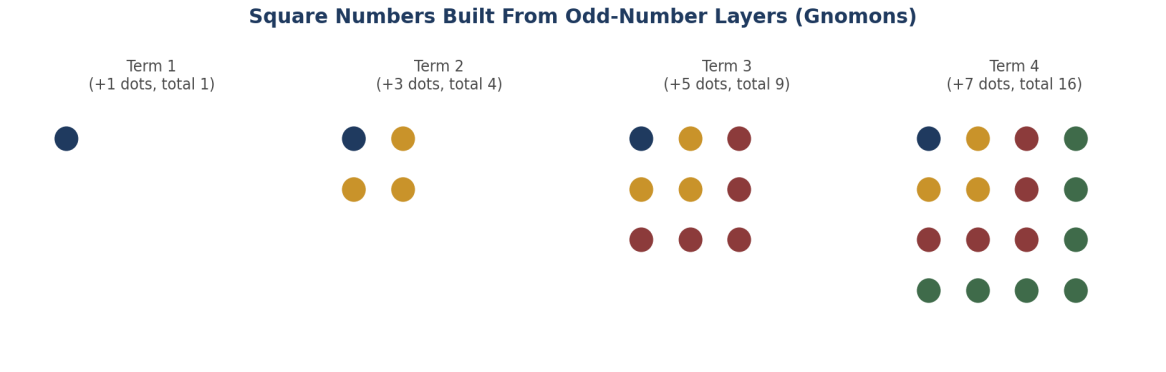
Four-panel isometric illustration, n×n×n stacked unit cubes per term, one accent colour per term (navy, gold, maroon, green), title states the multiplication and total above each stack
Fig. 1.7: The doubling pattern grows slowly at first, then extremely quickly From Your Textbook
Vertical bar chart, six bars (terms 1 –6), navy fill, value label above each bar, x -axis term number, y-axis value
Fig. 1.8: The Virahanka numbers: each term is the sum of the two terms before it From Your Textbook
Vertical bar chart, eight bars (terms 1 –8), gold fill, value label above each bar, x -axis term number, yaxis value
Fig. 1.9: The ratio of consecutive Virahanka numbers oscillates ever closer to the golden ratio, approximately 1.618 From Your Textbook
Line chart with markers, x -axis term position 3–9, y-axis ratio value, gold dashed horizontal reference line at 1.618, data labels above each marker
Teacher review note
All facts and numbers are taken directly from the provided source text. No additional historical dates or formulas have been invented. The activities use common classroom materials and are safe for grade‑6 students.
AI-generated learning material based on the uploaded source. Please review explanations, examples and assessments before assigning this lesson to students.