
Lesson 1.5: 1.2 Patterns in Numbers, 1.3 Patterns in Shapes and 1.4 From Patterns to Rules
- View
Chapter 1 · Lesson 5 of 8 · About 14 minutes
Learning objectives Extra Practice
- Construct Pascal's Triangle row by row using the sum‑of‑two‑above rule.
- Identify triangular numbers on the third diagonal of the triangle.
- Explain the term‑to‑term rule for the Virahanka sequence.
- Describe a pattern using both a term‑to‑term rule and a position‑to‑term rule.
- Relate pattern recognition to computational thinking.
- Recognise a visual pattern and translate it into number patterns.
- Describe the term‑to‑term and position‑to‑term rules for the two sequences.
- Extend the pattern to find any term without drawing all previous terms.
- Connect the translation process to computational thinking.
- Distinguish term‑to‑term and position‑to‑term rules.
- Apply the position‑to‑term rule for square, triangular and cube numbers.
- Use the quick‑reference table to compare sequence rules.
Getting started
In this lesson we explore Pascal's Triangle, a classic number pattern that reveals triangular numbers and connects to the Virahanka (Fibonacci) sequence. You will learn to build the triangle, spot hidden patterns, and describe rules in your own words.
Lesson Extra Practice
What Is Pascal's Triangle?
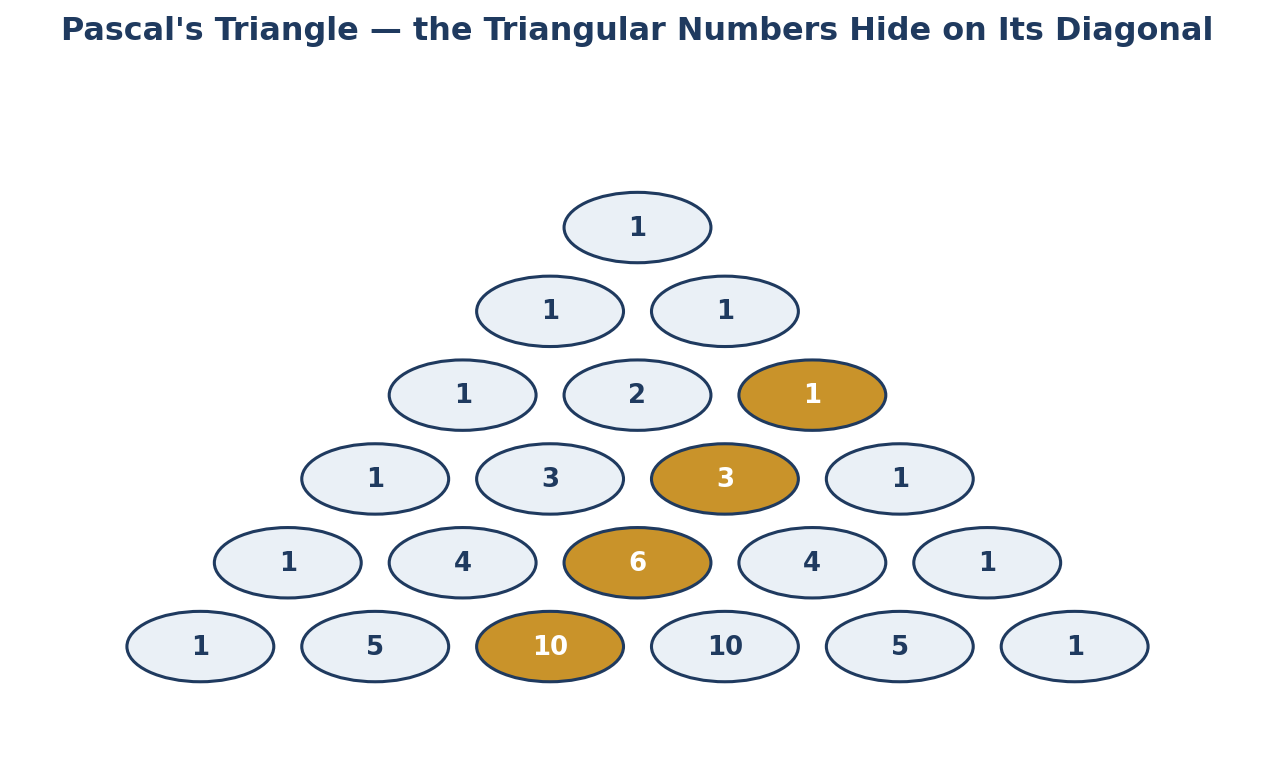
Pascal's Triangle starts with a single 1 at the top. Each new row begins and ends with 1, and every interior number equals the sum of the two numbers diagonally above it. The triangle is perfectly symmetric and was studied in India, Persia, China, and Europe long before Blaise Pascal.
- Top row: 1
- Each row starts and ends with 1
- Interior numbers = sum of two numbers above
Building the Triangle
- Write 1 as row 0.
- For each new row, place 1 at both ends.
- Add the two numbers above to fill each interior cell.
- Continue until the desired number of rows is reached.
| Row | Numbers |
|---|---|
| 0 | 1 |
| 1 | 1 1 |
| 2 | 1 2 1 |
| 3 | 1 3 3 1 |
| 4 | 1 4 6 4 1 |
| 5 | 1 5 10 10 5 1 |
Hidden Triangular Numbers
Look at the third diagonal (skip the outer 1s and the counting numbers 1,2,3,…). The numbers 1, 3, 6, 10 appear — exactly the triangular numbers from earlier in the chapter. This shows how two different patterns can describe the same underlying numbers.
- Triangular numbers: 1, 3, 6, 10, 15, …
- Found on the third diagonal of Pascal's Triangle
- Each equals the sum of the first n natural numbers
Connecting to Virahanka Numbers
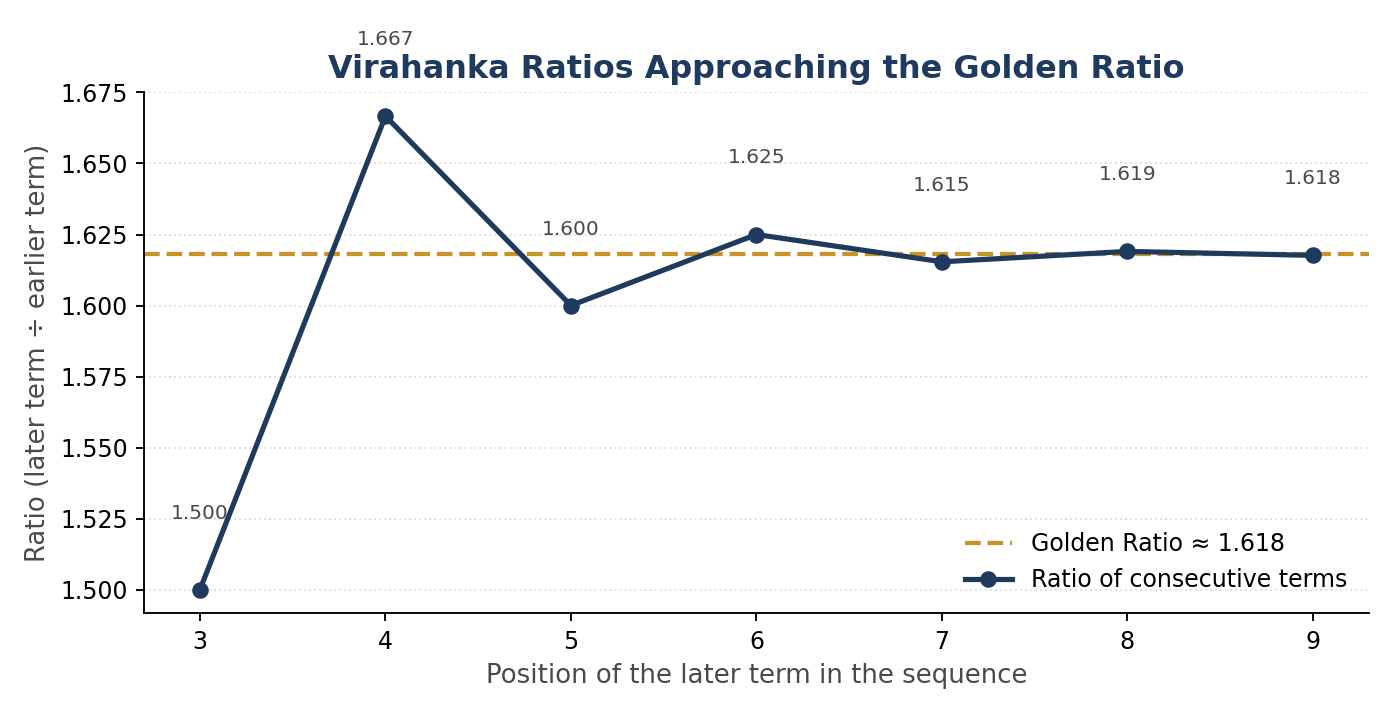
The Virahanka (Fibonacci‑style) sequence begins 1, 1, 2, 3, 5, 8, 13, 21. Each term is the sum of the two preceding terms. As the sequence grows, the ratio of consecutive terms approaches the golden ratio.
Quick Check Extra Practice
Problem: What are the next two terms of the Virahanka sequence 1, 1, 2, 3, 5, 8, 13, 21? State the rule you used.
Solution:
- Add the last two terms: 13 + 21 = 34.
- Add the new last two terms: 21 + 34 = 55.
- Rule: each term = sum of the two previous terms.
Answer: 34, 55 (term‑to‑term rule: add the two previous terms)
- Build the next row of Pascal's Triangle after 1, 5, 10, 10, 5, 1.
- The new row is 1, 6, 15, 20, 15, 6, 1.
- Consecutive triangular numbers in this row are 15 and 21 (but 21 is not in this row); the triangular numbers present are 1, 6, 15.
Translating Shapes to Numbers
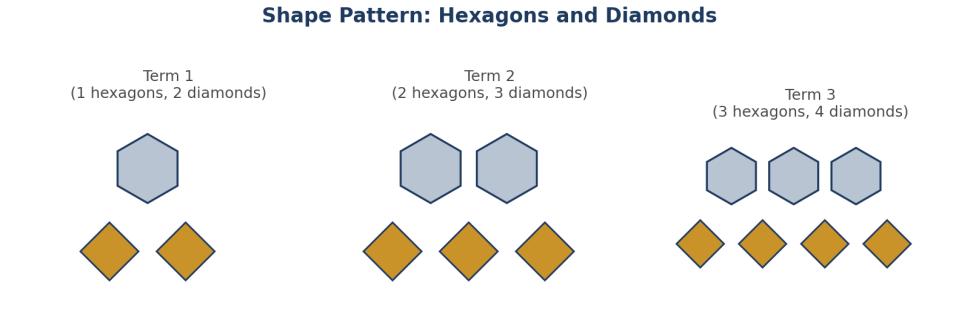
The first three terms of the shape pattern are shown below. Count the hexagons and diamonds in each term and record the numbers.
- Term 1: 1 hexagon, 2 diamonds
- Term 2: 2 hexagons, 3 diamonds
- Term 3: 3 hexagons, 4 diamonds
| Term | Hexagons | Diamonds |
|---|---|---|
| 1 | 1 | 2 |
| 2 | 2 | 3 |
| 3 | 3 | 4 |
| 4 | 4 | 5 |
| 5 | 5 | 6 |
Finding the Rule
From the table we see two clear number patterns. The hexagons follow the counting numbers, while the diamonds are always one more than the hexagons.
- Hexagon rule (position‑to‑term): H
= n
- Diamond rule (position‑to‑term): D
- Term‑to‑term rule for diamonds: each term adds 1 to the previous diamond count
Extending the Pattern
Using the position‑to‑term rules we can jump directly to any term. For example, the 10th term has 10 hexagons and 11 diamonds.
Find the 15th term Extra Practice
Problem: How many hexagons and diamonds are in term 15?
Solution:
- Apply H(15) = 15 → 15 hexagons
- Apply D(15) = 15 + 1 → 16 diamonds
Answer: 15 hexagons and 16 diamonds
Computational Thinking Connection
Turning a picture into numbers is exactly what a computer does when it learns to recognise patterns in data. The four‑step process — Observe, Identify, Predict, Verify — mirrors the steps we just used.
- Observe the shape arrangement.
- Identify the numerical relationship (diamonds = hexagons + 1).
- Predict the 100th term using the rule.
- Verify by checking a few earlier terms.
Two Ways to Describe a Rule
A term‑to‑term rule tells how to get the next term from the current one. A position‑to‑term rule lets us jump straight to the term at position n.
- Triangular numbers – term‑to‑term: add one more than the previous addition.
- Square numbers – term‑to‑term: add the next odd number (the gnomon).
- Doubling pattern – term‑to‑term: multiply the previous term by 2.
- Virahanka numbers – term‑to‑term: add the two previous terms.
- Triangular numbers – position‑to‑term: n × (n + 1) ÷ 2.
- Square numbers – position‑to‑term: n × n.
- Cube numbers – position‑to‑term: n × n × n.
- Doubling pattern – position‑to‑term: 2^(n‑1).
- Virahanka numbers – no simple one‑line rule for Class 6.
Quick Reference Table
| Sequence | Term‑to‑Term Rule | Position‑to‑Term Rule |
|---|---|---|
| Triangular Numbers | Add one more than the previous addition | n × (n + 1) ÷ 2 |
| Square Numbers | Add the next odd number (gnomon) | n × n |
| Cube Numbers | Grows in three directions at once | n × n × n |
| Doubling Pattern | Multiply the previous term by 2 | 2^(n‑1) |
| Virahanka Numbers | Add the two previous terms | No simple one‑line rule for Class 6 |
Worked Example: Using Position‑to‑Term Rules
Find specific terms Extra Practice
Problem: What are the 12th and 100th square numbers? What are the 10th triangular number and the 5th cube number?
Solution:
- 12th square: 12 × 12 = 144.
- 100th square: 100 × 100 = 10 000.
- 10th triangular: 10 × 11 ÷ 2 = 55.
- 5th cube: 5 × 5 × 5 = 125.
Answer: 12th square = 144; 100th square = 10 000; 10th triangular = 55; 5th cube = 125.
Connecting to Computational Thinking
Writing a clear position‑to‑term rule is exactly what a programmer does when giving a computer a formula to generate any term instantly. This mirrors the Observe‑Identify‑Predict‑Verify cycle used in AI pattern recognition.
- Observe the sequence.
- Identify the rule (term‑to‑term or position‑to‑term).
- Predict a far‑away term using the rule.
- Verify by checking a few earlier terms.
Teacher–student conversation Extra Practice
Teacher: Can anyone tell me how we get the number 6 in row 4 of Pascal's Triangle?
Student: It is the sum of the two numbers above it: 3 and 3 from row 3.
Teacher: Exactly. And notice that 6 also appears on the third diagonal — it is a triangular number.
Teacher: What do you notice about the number of diamonds compared to hexagons in each term?
Student: The diamonds are always one more than the hexagons.
Teacher: Exactly. Can you write that as a rule using the term number n?
Teacher: If we wanted the 50th term without drawing, what would we do?
Student: Use the rules: 50 hexagons and 51 diamonds.
Teacher: Well done. That is how a computer would compute it instantly.
Teacher: Why is a position‑to‑term rule more powerful than a term‑to‑term rule?
Student: Because you can find the 100th term without calculating the first 99.
Teacher: Exactly — it saves time and lets a computer compute any term directly.
Real-world connections Extra Practice
- Computer algorithms use pattern recognition similar to spotting diagonals in Pascal's Triangle.
- The golden ratio from Virahanka numbers appears in art, architecture, and nature.
- Tile designs where one shape repeats with a constant offset.
- Programming loops that generate sequences based on a simple formula.
- Analyzing growth patterns in crystals or honeycomb structures.
- Computer graphics use square‑number rules to calculate pixel grids.
- Triangular numbers appear in arranging seats in a theater.
- Doubling patterns model population growth in biology.
Build Your Own Pascal Triangle Extra Practice
- Draw a triangle grid on graph paper.
- Fill row 0 with a single 1.
- Follow the sum‑of‑two‑above rule to complete rows 1‑7.
- Highlight the third diagonal and list the triangular numbers you find.
Materials: Graph paper, pencil, ruler, colored pencils for highlighting
Build the Pattern Extra Practice
- Cut out paper hexagons and diamonds.
- Arrange them to form the first four terms.
- Count and record the numbers in a table.
- Write the two rules in your own words.
Materials: Coloured paper, scissors, glue, grid paper
Create Your Own Sequence Rule Extra Practice
- Choose a simple pattern (e.g., add 3 each time).
- Write both a term‑to‑term rule and a position‑to‑term rule.
- Test the rules by finding the 7th and 20th terms.
- Swap with a partner and verify each other’s rules.
Materials: Paper, pencil, calculator (optional).
Important points to remember Extra Practice
- Pascal's Triangle is built by adding the two numbers above each interior cell.
- Triangular numbers appear on the third diagonal of the triangle.
- The Virahanka sequence uses a term‑to‑term rule: each term = sum of the two previous terms.
- Patterns can be described with both term‑to‑term and position‑to‑term rules.
- Recognising patterns is a core skill in computational thinking and AI.
- Visual patterns can be translated into number sequences.
- The hexagon sequence follows H
- The diamond sequence follows D
- Position‑to‑term rules let us find any term directly.
- Term‑to‑term rules describe step‑by‑step growth.
- Position‑to‑term rules give a direct formula using n.
- Square numbers: n²; Triangular numbers: n(n+1)/2; Cube numbers: n³; Doubling: 2^(n‑1).
- Clear rules enable computational thinking and AI pattern detection.
Lesson summary Extra Practice
We constructed Pascal's Triangle, discovered triangular numbers hidden on its third diagonal, and linked the Virahanka sequence to the golden ratio. Understanding these connections helps us see how simple rules generate rich patterns — a foundation for mathematical reasoning and computer science.
We learned to convert a repeating shape pattern into two number patterns, discovered the simple algebraic rules linking term number to shape counts, and saw how this mirrors the way computers detect patterns in data.
We learned to translate observed patterns into two kinds of rules, used a reference table to compare them, applied position‑to‑term formulas to find distant terms, and linked rule‑writing to the way computers learn patterns.
Illustrations retained from the textbook From Your Textbook
Fig. 1.10: The first six rows of Pascal's Triangle, with the triangular numbers 1, 3, 6, 10 highlighted along a diagonal From Your Textbook
Symmetric triangle of circled numbers, six rows, light-blue circles with navy numerals, gold-filled circles with white numerals marking the triangular-number diagonal
Fig. 1.11: A shape pattern: the number of diamonds is always one more than the number of hexagons From Your Textbook
Three-panel illustration, grey hexagons in a row above gold diamonds in a row, term label and shape-count caption above each panel
Figure 1.83: Illustration from the textbook From Your Textbook
Teacher review note
The source text provides the definition of Pascal's Triangle, the location of triangular numbers, and the Virahanka quick‑check. All facts used here come directly from that source. No additional historical dates or formulas were invented. All facts and rules are taken directly from the provided source text. No additional information was invented.
AI-generated learning material based on the uploaded source. Please review explanations, examples and assessments before assigning this lesson to students.