
Lesson 1.6: 1.5 The Pattern-Thinking Process and 1.6 Patterns in Nature and Everyday Technology
- View
Chapter 1 · Lesson 6 of 8 · About 13 minutes
Learning objectives Extra Practice
- Recognise a pattern in a set of numbers and explain why it is a pattern rather than a coincidence.
- Apply the four‑step pattern‑thinking process: Observe, Identify, Predict, Verify.
- Describe a pattern using both a term‑to‑term rule and a position‑to‑term rule.
- Connect pattern recognition to computational thinking and AI learning.
- Represent a pattern with a table of differences and a simple algebraic rule.
- Identify Virahanka numbers in sunflower seed spirals and nautilus shells.
- Describe repeating cycles in traffic signals, washing machines, and music.
- Explain how the four‑step pattern‑thinking process (Observe, Identify, Predict, Verify) links to computational thinking.
- Write term‑to‑term and position‑to‑term rules for a given pattern.
- Create a simple visual representation of a natural or technological pattern.
Getting started
In this lesson you will learn a reliable four‑step method for discovering the rule behind any number pattern. By observing, identifying changes, predicting, and verifying, you can solve unfamiliar sequences with confidence and see how the same process powers computational thinking and artificial intelligence.
Lesson Extra Practice
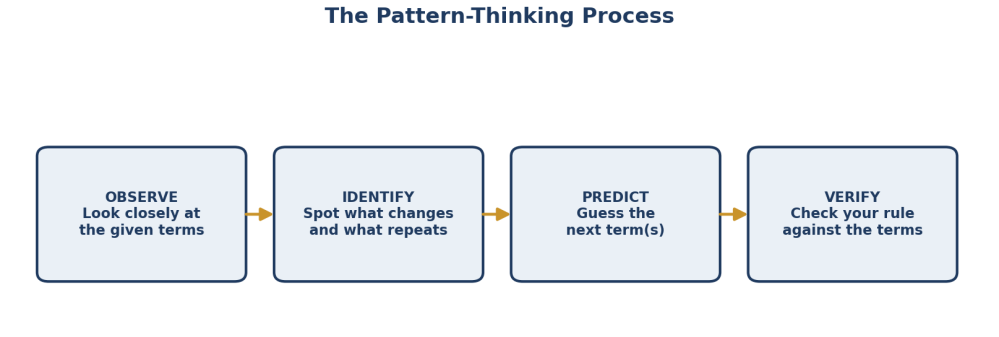
The Four‑Step Pattern‑Thinking Process
Mathematicians, scientists, and programmers all use the same four steps when they search for a rule behind a sequence. Following the steps deliberately makes any pattern problem easier to solve.
- Observe the given terms exactly as they appear.
- Identify what changes from term to term and what stays the same.
- Predict the next term or any later term using the discovered rule.
- Verify the prediction by checking it against a known term or an alternative rule.
- Observe
- Identify
- Predict
- Verify
Worked Example: 2, 6, 12, 20, 30
Apply the four steps to the sequence 2, 6, 12, 20, 30 and find the next term.
Finding the next term Extra Practice
Problem: Sequence: 2, 6, 12, 20, 30. What is the sixth term?
Solution:
- Observe: the terms increase and the gaps grow larger.
- Identify: differences are 4, 6, 8, 10 — each difference rises by 2.
- Predict: next difference should be 12, so next term = 30 + 12 = 42.
- Verify: position‑to‑term rule n × (n + 1) gives 6 × 7 = 42, matching the prediction.
Answer: 42
| Term number | Term value | Term‑to‑term difference | Position‑to‑term rule n×(n+1) |
|---|---|---|---|
| 1 | 2 | — | 1×2 = 2 |
| 2 | 6 | 4 | 2×3 = 6 |
| 3 | 12 | 6 | 3×4 = 12 |
| 4 | 20 | 8 | 4×5 = 20 |
| 5 | 30 | 10 | 5×6 = 30 |
| 6 | 42 | 12 | 6×7 = 42 |
Link to Computational Thinking and AI
The same four steps underlie how computers learn patterns from data. A voice assistant observes many speech samples, identifies recurring sound patterns, predicts the meaning of new sentences, and constantly verifies and corrects its predictions.
- Observe → training data collection
- Identify → feature extraction
- Predict → model inference
- Verify → loss calculation and model update
Practice Activity
Use the four‑step process on the sequence 3, 8, 15, 24, 35. Write the differences, predict the next term, and verify with a position‑to‑term rule.
Patterns in Nature
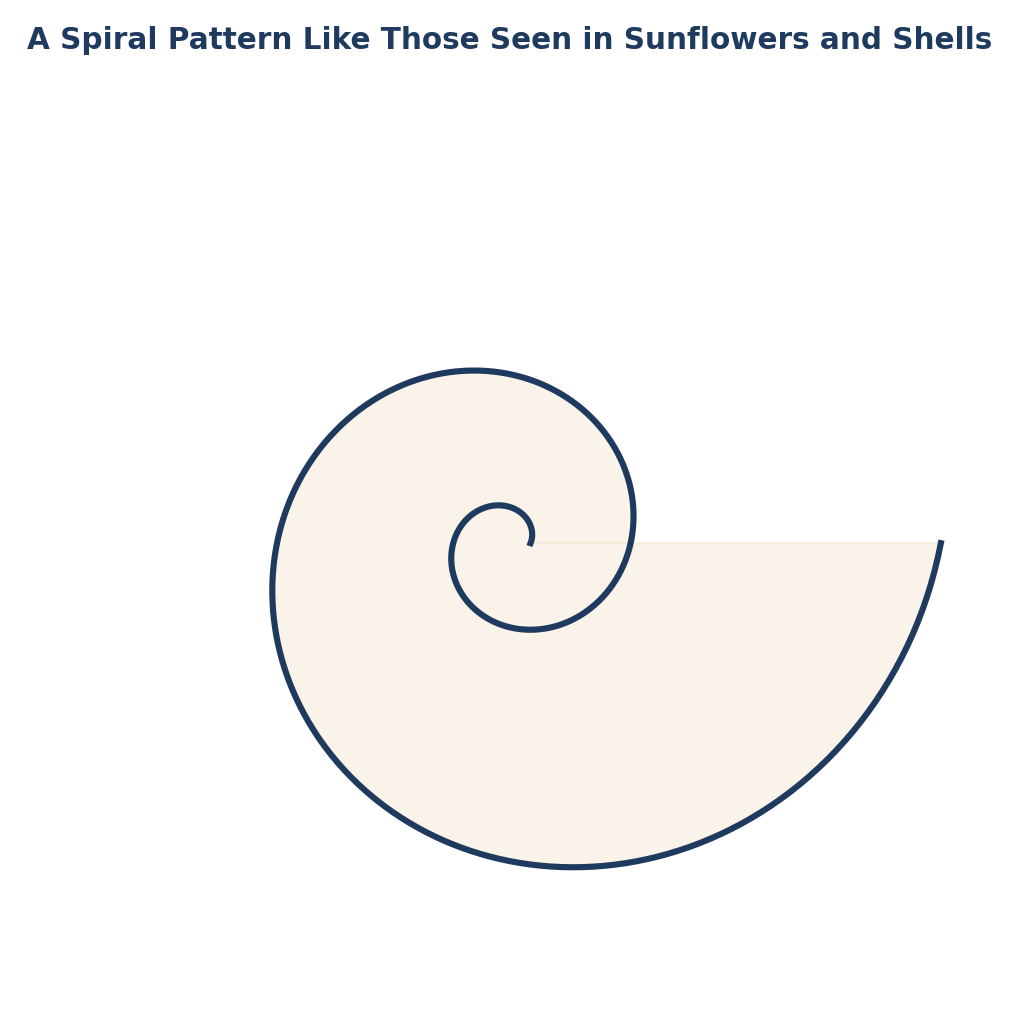
A sunflower packs hundreds of seeds by placing each new seed at a fixed angle from the previous one. The seeds form two families of spirals — one clockwise, one anticlockwise — and the numbers of spirals are almost always neighbouring Virahanka numbers (e.g., 34 and 55). A nautilus shell grows by adding a new chamber that is a constant proportion larger than the last, producing a logarithmic spiral.
- Sunflower seed heads → clockwise and anticlockwise spiral counts are consecutive Virahanka numbers.
- Nautilus shell → each growth ring is a fixed ratio larger than the previous ring.
- Pinecone scales → similar paired spirals based on Virahanka numbers.
Patterns in Everyday Technology
Engineers deliberately design repeating cycles so that users can predict what happens next. A traffic signal follows the fixed order red → green → amber → red. A washing machine runs through fill, wash, rinse, spin, then repeats. Music is built from repeating beats and rhythmic patterns that composers choose, just as Virahanka originally counted syllable patterns in verse.
- Traffic signal: repeating 3‑state cycle.
- Washing machine: 4‑stage cycle repeated each load.
- Music: rhythmic patterns that repeat and vary.
| Feature | Natural Example | Technological Example |
|---|---|---|
| Growth rule | Fixed angle or ratio | Fixed sequence of states |
| Predictability | Statistical (spiral counts) | Exact (signal timing) |
| Underlying numbers | Virahanka numbers | Simple counting cycles |
The Four‑Step Pattern‑Thinking Process
Computational thinking uses the same steps mathematicians use to work with patterns. Practising them helps you describe any new situation in terms of a known rule.
- Observe – look at the data or object and note regularities.
- Identify – name the pattern (e.g., Virahanka, doubling, 3‑state cycle).
- Predict – use the rule to state the next term or state.
- Verify – check the prediction against the actual next observation.
Extending a Virahanka Sequence Extra Practice
Problem: Given the start 1, 1, 2, 3, 5, 8, write the next three terms and state the term‑to‑term rule.
Solution:
- Observe that each term after the first two is the sum of the two preceding terms.
- Apply the rule: 5 + 8 = 13, 8 + 13 = 21, 13 + 21 = 34.
- Write the term‑to‑term rule: “Add the previous two numbers to get the next number.”
Answer: Next three terms: 13, 21, 34. Term‑to‑term rule: aₙ = aₙ₋₁ + aₙ₋₂ for n ≥ 3.
Writing Rules for Patterns
A clear rule lets anyone — or a computer — continue the pattern without seeing every earlier term. Write both a term‑to‑term rule (how to get the next term from the previous ones) and a position‑to‑term rule (a formula using the term’s position).
- Term‑to‑term example (doubling): “Multiply the previous term by 2.”
- Position‑to‑term example (doubling): “Term n = 2ⁿ⁻¹.”
- Term‑to‑term example (traffic signal): “Move to the next colour in the list red, green, amber.”
- Position‑to‑term example (traffic signal): “Colour at step n = list[(n‑1) mod 3].”
Teacher–student conversation Extra Practice
Teacher: What do you notice about the differences in the worked example?
Student: They go up by 2 each time: 4, 6, 8, 10.
Teacher: Exactly. That constant second difference tells us the original sequence follows a quadratic rule, which we confirmed with n×(n+1).
Teacher: Look at the sunflower picture. What do you notice about the spirals?
Student: There are two sets of spirals, one going each way, and the numbers of spirals are 34 and 55.
Teacher: Exactly. Those numbers are consecutive Virahanka numbers. Can you predict the next pair if the flower kept growing?
Teacher: How does a traffic signal use a pattern to keep people safe?
Student: It repeats red, green, amber in the same order so drivers know what comes next.
Teacher: Right. That repeating cycle is a simple pattern a computer can follow without any ‘thinking’.
Real-world connections Extra Practice
- Predicting traffic light cycles using observed timing patterns.
- Recognising spiral patterns in sunflower seed heads related to Fibonacci numbers.
- Training a spam filter to identify patterns in email content.
- Architects use spiral growth ratios for efficient packing in building layouts.
- Computer vision algorithms detect Virahanka‑based spirals to classify plant images.
- Traffic‑control software models signal cycles as finite‑state machines.
- Music‑generation programs create rhythms by repeating and varying beat patterns.
Pattern Detective Extra Practice
- Choose any number sequence from a magazine or website.
- Apply the four‑step process on paper.
- Share your rule and verification with a partner.
- Discuss whether the rule could be used by a computer program.
Materials: Paper, pencil, printed sequence examples
Spiral Seed Count Extra Practice
- Draw a large circle and mark points around it at a fixed angle (e.g., 137.5°).
- Connect successive points to see the two spiral families.
- Count the spirals in each direction and record the numbers.
- Compare your counts with known Virahanka pairs.
Materials: Paper, protractor, ruler, pencil.
Design a Pattern Cycle Extra Practice
- Choose a daily routine (e.g., morning tasks).
- List the steps in order and decide how many times the cycle repeats.
- Write a term‑to‑term rule and a position‑to‑term rule for the cycle.
- Swap rules with a partner and have them generate the first five cycles.
Materials: Paper, pencil.
Important points to remember Extra Practice
- The four‑step process (Observe, Identify, Predict, Verify) works for any pattern.
- Differences between terms often reveal a hidden simpler pattern.
- A position‑to‑term rule lets you jump directly to any term.
- The same steps are the foundation of computational thinking and AI learning.
- Verification prevents mistakes from an incorrect rule.
- Virahanka numbers appear in seed heads, pinecones, and shells as paired spiral counts.
- Technology uses deliberate repeating cycles (traffic lights, washing machines, music).
- The four‑step process — Observe, Identify, Predict, Verify — is the core of computational thinking.
- A pattern can be described by a term‑to‑term rule and a position‑to‑term rule.
- Recognising the same pattern in different contexts lets us transfer solutions across domains.
Lesson summary Extra Practice
By mastering the four‑step pattern‑thinking process you gain a powerful tool for mathematics, science, and computer science. Practice observing, identifying, predicting, and verifying on many sequences to build confidence and see the connections to real‑world technology.
We have seen that the number patterns studied earlier are not just abstract exercises; they shape the arrangement of seeds in a sunflower, the growth of a nautilus shell, and the engineered cycles that run traffic lights, washing machines, and music. By practising the Observe‑Identify‑Predict‑Verify cycle and writing clear rules, you develop the pattern‑recognition skills that underlie both mathematics and computer science.
Illustrations retained from the textbook From Your Textbook
Fig. 1.13: A schematic spiral of the kind seen in sunflower seed heads, pinecones, and nautilus shells From Your Textbook
Single logarithmic spiral on a polar plot, navy stroke, pale gold fill, no axes or gridlines, centred composition
Figure 1.102: Illustration from the textbook From Your Textbook
Teacher review note
The source text provides all factual content used in this lesson. No additional facts were invented.
AI-generated learning material based on the uploaded source. Please review explanations, examples and assessments before assigning this lesson to students.