
Lesson 1.1: Introduction: The World Runs on Patterns
- View
Chapter 1 · Lesson 1 of 8 · About 10 minutes
Learning objectives Extra Practice
- Identify a pattern in numbers, shapes, or events and explain why it is a pattern rather than a coincidence.
- Describe, extend, and create simple number patterns such as skip‑counting sequences.
- Represent a pattern using dots, grids, tables, or charts.
- State the rule of a pattern in words using both a term‑to‑term rule and a position‑to‑term rule.
- Connect pattern recognition to the four‑step thinking process used in computational thinking and artificial intelligence.
- Observe patterns in everyday life and in nature.
Getting started
Patterns are everywhere — from the colourful rangoli at a festival entrance to the repeating cycle of a traffic light and the weekly school timetable. In this chapter you will learn to recognise a pattern, describe how it grows or repeats, and write a rule that lets anyone (or a computer) predict the next term without seeing every previous one. Understanding patterns is the first step toward computational thinking and the way machines learn to spot regularities in data.
Lesson Extra Practice
What Is a Pattern?
A pattern is an arrangement that repeats, grows, or changes according to a rule. Because the rule is consistent, we can predict what comes next without having to see every step. Mathematicians and computer scientists study patterns because they allow us to compress information and make reliable predictions.
- Repeats: the same element appears again and again (e.g., red‑green‑amber‑red).
- Grows: each step adds or removes something in a predictable way (e.g., 2, 4, 6, 8 …).
- Changes: the rule may involve alternating operations (e.g., add 3, then subtract 1).
When you notice a pattern, you are doing the same mental work that a computer does when it learns to recognise a face or a fraudulent transaction.
Patterns in Everyday Life
The source text gives three familiar examples that illustrate the three ways patterns appear.
- Rangoli – a symmetric design built from dots and coloured powder; the pattern repeats across the floor.
- School timetable – the same subjects return on the same days each week; the cycle repeats every Monday.
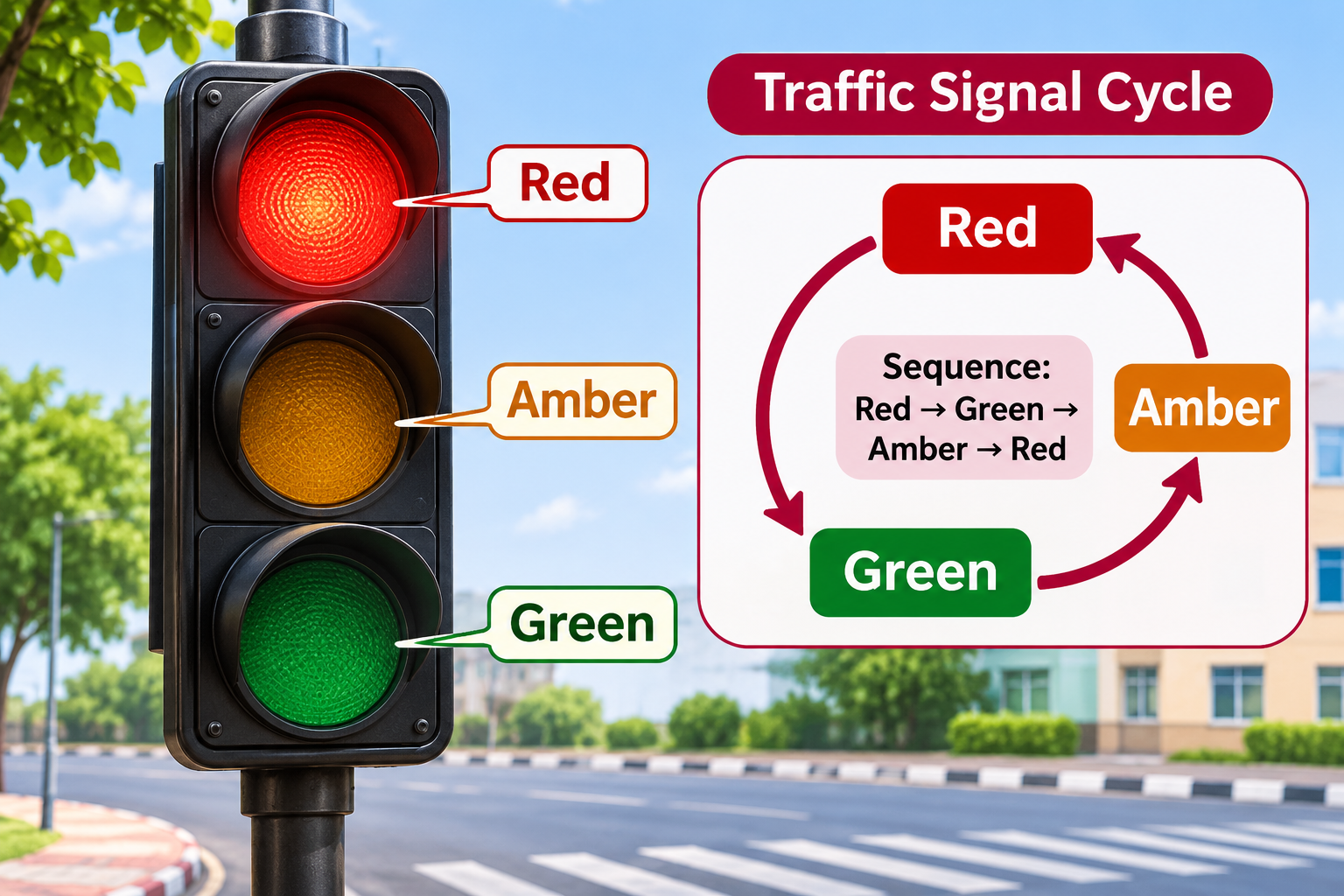
- Traffic signal – red, green, amber, then red again; the order never changes so road users can predict the next colour.
| Pattern | Type | Rule Description | Prediction Example |
|---|---|---|---|
| Rangoli | Repeating spatial | Place dots in a symmetric grid; repeat the motif. | Next motif will be identical to the first. |
| Timetable | Repeating temporal | Weekly cycle of 5 days; same subjects each day. | Next Monday will have the same first period as today. |
| Traffic signal | Cyclic sequential | Red → Green → Amber → Red (fixed order). | After amber the light will turn red. |
Image prompt 1: section 'Patterns in Everyday Life' after the comparison table

All three examples share a common idea: a rule that lets us say what comes next without watching every single occurrence.
Describing and Extending Number Patterns
Number patterns are the easiest to write down and analyse. A simple skip‑counting pattern such as 3, 6, 9, 12 … follows the rule “add 3 each time”. We can describe it in two ways.
- Term‑to‑term rule: “Start at 3, then add 3 to get the next term.”
- Position‑to‑term rule: “The nth term equals 3 × n.”
- Write the first four terms of the pattern.
- Identify what changes from term to term.
- Express the change as a term‑to‑term rule.
- Find a formula that gives the term directly from its position (position‑to‑term rule).
- Use the formula to predict the 10th term without listing all previous terms.
Extending a Skip‑Counting Pattern Extra Practice
Problem: Extend the pattern 5, 10, 15, 20 … and find the 12th term.
Solution:
- Observe the difference between consecutive terms: 10‑5 = 5, 15‑10 = 5, 20‑15 = 5.
- Term‑to‑term rule: start at 5, add 5 each time.
- Position‑to‑term rule: term n = 5 × n.
- Calculate the 12th term: 5 × 12 = 60.
Answer: The 12th term is 60.
Image prompt 2: section 'Describing and Extending Number Patterns' after the worked example
The Four‑Step Pattern‑Thinking Process
Whether you are a student solving a puzzle or a computer learning from data, the same four steps are used.
- Observe – look at the given terms or shapes and note what stays the same and what changes.
- Identify – state the rule in your own words (term‑to‑term and/or position‑to‑term).
- Predict – use the rule to write the next few terms or the term at a given position.
- Verify – check your prediction against the actual next term (if known) or test the rule on a new example.
This process is the foundation of computational thinking. When a machine learning model is trained, it observes many examples, identifies statistical regularities, predicts outcomes for new data, and verifies its predictions against labelled answers.
Teacher–student conversation Extra Practice
Teacher: Look at the traffic signal pattern: red, green, amber, red … What is the term‑to‑term rule?
Student: The rule is ‘go to the next colour in the fixed order red → green → amber → red’.
Teacher: Excellent. Now can you write a position‑to‑term rule for the 5th signal in the cycle?
Teacher: If we start counting at 1 for red, what colour appears at position 7?
Student: Position 7 is the same as position 3 because the cycle length is 4. So it’s amber.
Teacher: Right — using the cycle length lets us predict far ahead without listing every step.
Real-world connections Extra Practice
- Designing floor tiles or textiles with repeating motifs.
- Programming traffic‑light controllers so the sequence never changes.
- Creating algorithms that detect fraudulent credit‑card transactions by spending patterns.
- Predicting the next bus arrival using the timetable pattern.
Build Your Own Rangoli Pattern Extra Practice
- Draw a 5 × 5 grid of equally spaced dots on graph paper.
- Choose a simple motif (e.g., a diagonal line of three dots).
- Repeat the motif by translating it across the grid so the design is symmetric.
- Colour the dots to highlight the repeating unit.
- Write the term‑to‑term rule that describes how the motif moves from one position to the next.
Materials: Graph paper, pencil, coloured pencils or markers.
Home Extension: Find a Pattern in Your Kitchen Extra Practice
- Look at the arrangement of plates, cups, or spice jars.
- Sketch the arrangement and label the repeating unit.
- Describe the rule in words and, if possible, as a position‑to‑term rule.
- Share your finding with the class next lesson.
Materials: Paper, pencil, a kitchen shelf or cupboard.
Important points to remember Extra Practice
- A pattern repeats, grows, or changes according to a consistent rule.
- Patterns can be spatial (rangoli), temporal (timetable), or sequential (traffic lights).
- Number patterns are described with a term‑to‑term rule and a position‑to‑term rule.
- The four‑step process — Observe, Identify, Predict, Verify — is used by both humans and computers.
- Recognising patterns lets us make predictions without observing every case.
Lesson summary Extra Practice
In this lesson you learned that patterns are all around us — from festival rangoli to school timetables and traffic signals. You practiced spotting the rule behind a pattern, writing it in two ways, and using the four‑step thinking process that underlies computational thinking. The activities gave you hands‑on experience creating and describing patterns, preparing you for the more complex number patterns (triangular, square, Fibonacci) that appear later in the chapter.
Teacher review note
The source text provides only the introductory examples and the general learning objectives for the chapter. Detailed content on triangular numbers, square numbers, Pascal's Triangle, and the golden ratio is not included in the source; those topics will be covered in later lessons. This lesson therefore focuses on the foundational ideas of pattern recognition, everyday examples, simple number patterns, and the four‑step thinking process.