
Lesson 1.2: 1.1 What Is a Pattern?
- View
Chapter 1 · Lesson 2 of 8 · About 11 minutes
Learning objectives Extra Practice
- Recognise a pattern in numbers, shapes, or events and explain why it is a pattern rather than a coincidence.
- Identify the four main families of patterns: repeating, growing, shrinking, and visual.
- Use a 10×10 number grid to discover hidden structure such as diagonal stripes formed by multiples.
- State the rule of a pattern in words using both a term‑to‑term rule and a position‑to‑term rule.
- Connect pattern recognition to computational thinking and how machines learn to spot patterns.
Getting started
A pattern is an arrangement of numbers, shapes, colours, or events that follows a rule, so once you know the rule you can predict what comes next. This lesson introduces the idea of a pattern, shows how patterns appear in number grids, and teaches you how to describe and extend them using both term‑to‑term and position‑to‑term rules.
Lesson Extra Practice
1. What Is a Pattern?
A pattern is not just something that repeats; it is something that repeats or changes in a predictable way. The key word is rule. When you see the sequence 5, 10, 15, 20 you sense that the next number is 25 because each term is 5 more than the previous one. That sense of "knowing what comes next" is what makes a pattern a pattern.
- Terms – the actual numbers, shapes, or colours you can see.
- Rule – the hidden logic that connects one term to the next.
- Predictability – once the rule is known, the whole pattern can be extended indefinitely.
Mathematicians and computer scientists spend a lot of time uncovering the rule behind a set of terms because the rule makes the pattern completely predictable.
2. Families of Patterns
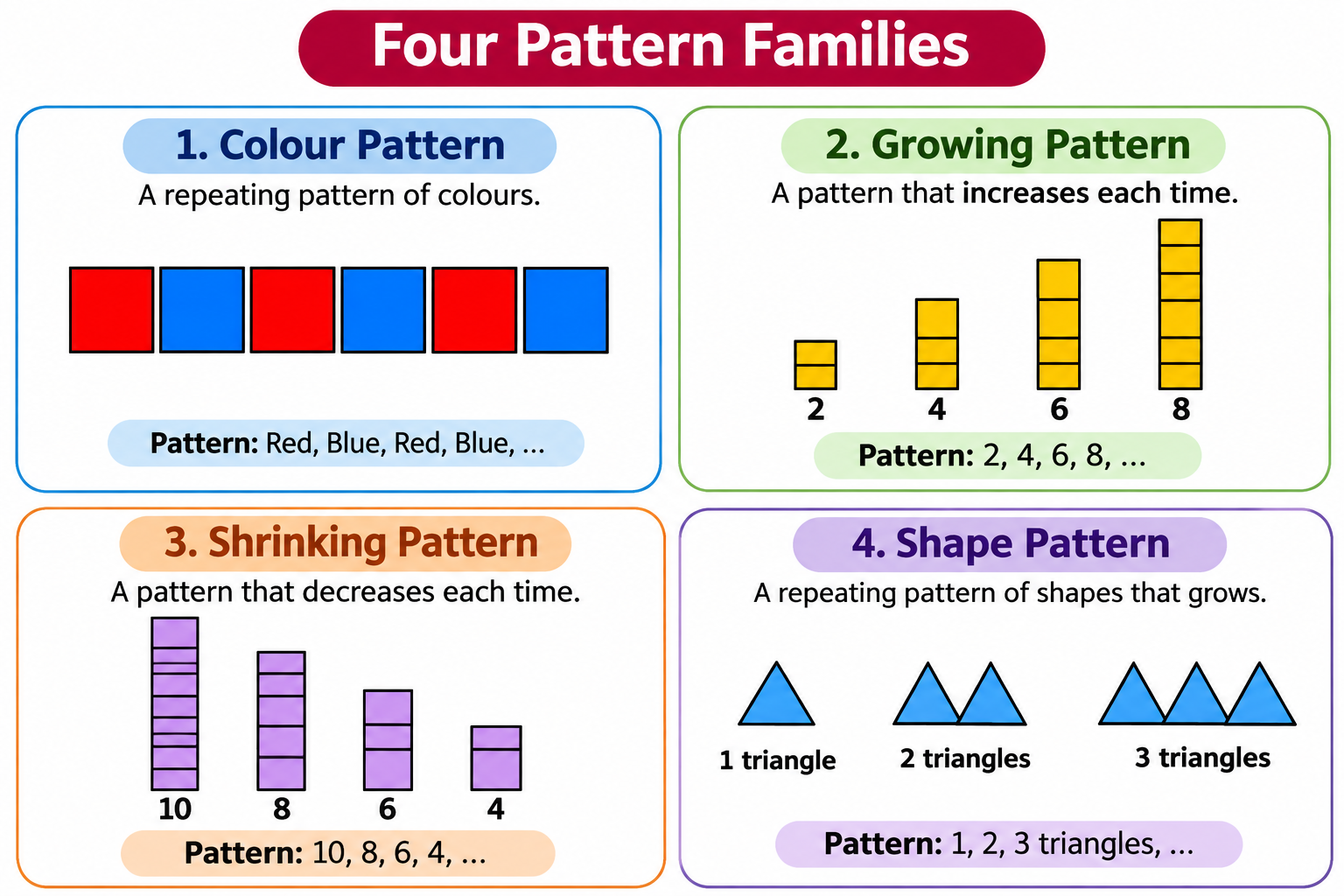
Patterns generally fall into four broad families. Knowing their names helps you talk about patterns the way mathematicians do.
- Repeating patterns – a fixed group appears again and again (e.g., red‑blue‑red‑blue).
- Growing patterns – each term is larger than the one before, following a fixed rule (e.g., 2, 4, 6, 8).
- Shrinking patterns – each term becomes smaller according to a rule (e.g., 100, 90, 80, 70).
- Visual or shape patterns – the rule governs how a picture, tile, or arrangement changes from step to step.
| Family | Example | Rule Description |
|---|---|---|
| Repeating | A, B, A, B, A, B | Alternate two items |
| Growing | 3, 6, 9, 12 | Add 3 each time |
| Shrinking | 50, 45, 40, 35 | Subtract 5 each time |
| Visual | ▲, ▲▲, ▲▲▲ | Add one triangle each step |
Image prompt 1: Section 2 – Families of Patterns
3. Discovering Patterns in a Number Grid
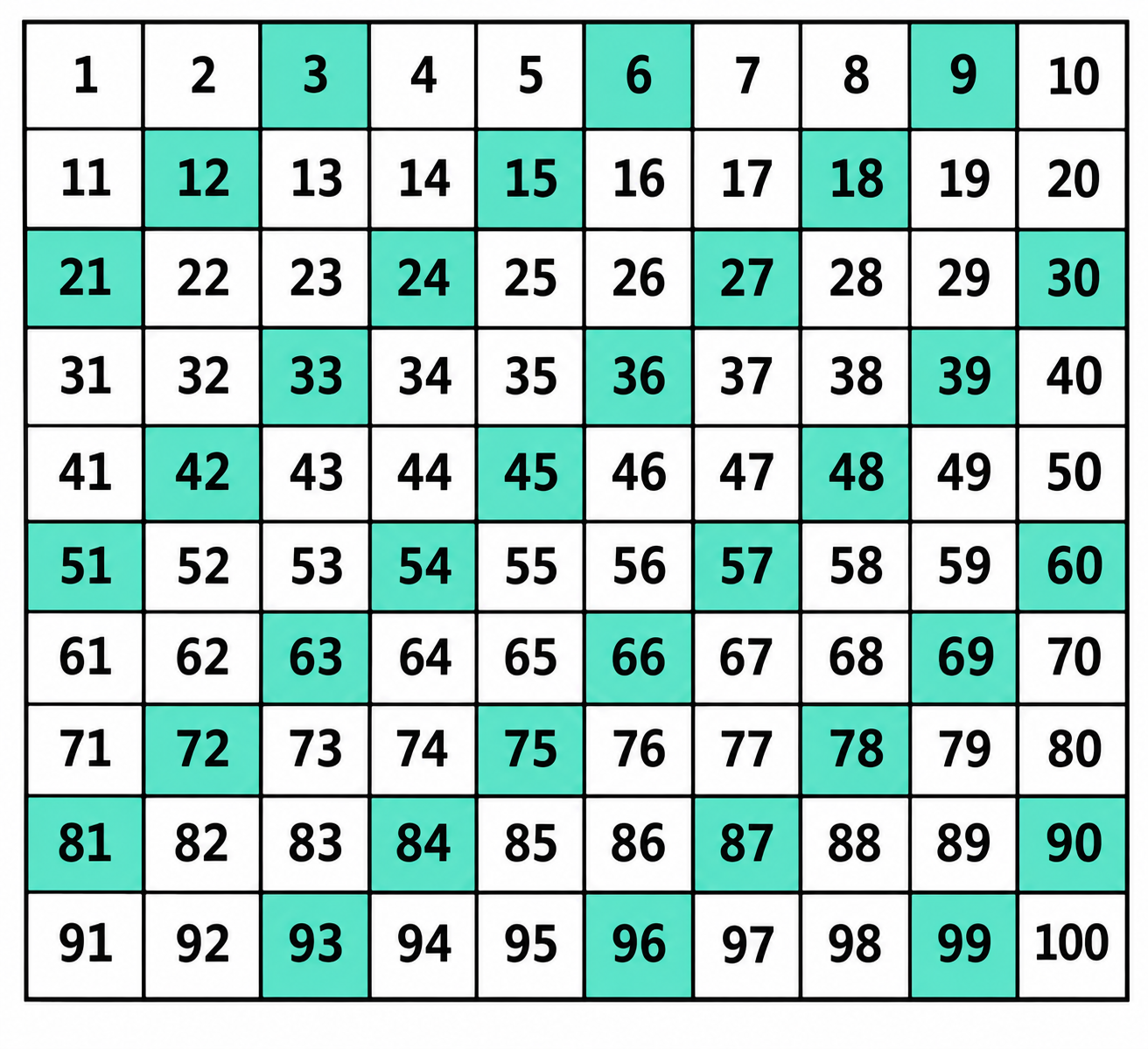
A 10×10 grid of the first hundred counting numbers is a powerful tool for seeing hidden structure. When every multiple of 3 is shaded, the shaded squares line up into clean diagonal stripes running across the grid.
- Each row of the grid is exactly 10 numbers wide.
- 10 is not a multiple of 3, so when the shading wraps to the next row it lands one column to the left.
- This interaction between grid width (10) and the multiple rule (3) creates a second‑order diagonal pattern that neither rule shows alone.
Quick Check: Look at the sequence 3, 6, 9, 12, ___. What number comes next? What rule did you use? Now imagine shading multiples of 4 on the same 10×10 grid – would the stripes still run diagonally? Sketch a 5×5 version to test your prediction.
Image prompt 2: Section 3 – Discovering Patterns in a Number Grid
4. Describing the Rule: Term‑to‑Term and Position‑to‑Term
Every pattern can be described in two ways. A term‑to‑term rule tells how to get from one term to the next. A position‑to‑term rule tells the value of any term based on its position (1st, 2nd, 3rd, …).
Finding the Rule for 3, 6, 9, 12 Extra Practice
Problem: Write both a term‑to‑term rule and a position‑to‑term rule for the sequence 3, 6, 9, 12.
Solution:
- Observe the difference between consecutive terms: 6‑3 = 3, 9‑6 = 3, 12‑9 = 3.
- Term‑to‑term rule: Start at 3, then add 3 to get the next term.
- Position‑to‑term rule: The nth term equals 3 × n (because 3×1=3, 3×2=6, 3×3=9, 3×4=12).
Answer: Term‑to‑term: add 3. Position‑to‑term: term = 3n.
- Term‑to‑term rules are useful for extending a pattern step by step.
- Position‑to‑term rules let you jump directly to any term, which is handy for large positions.
5. Pattern Thinking and Computational Thinking
The four‑step pattern‑thinking process – Observe, Identify, Predict, Verify – is the same process used in computational thinking and artificial intelligence. Computers are trained to spot patterns in data by repeatedly observing examples, identifying a rule, predicting new cases, and verifying the predictions.
- Observe – look at the given terms or shapes carefully.
- Identify – find the rule that connects the terms.
- Predict – use the rule to say what comes next or what the 20th term would be.
- Verify – check your prediction against the actual next term or by applying the rule again.
When you practice this process with number grids, shape sequences, or real‑world data, you are building the same skills that data scientists use every day.
Teacher–student conversation Extra Practice
Teacher: Look at the shaded multiples of 3 on the 10×10 grid. What do you notice about the pattern of the shaded squares?
Student: They make diagonal lines that go from the top right toward the bottom left.
Teacher: Exactly. Why do you think the diagonals appear instead of straight columns?
Teacher: Can you write a position‑to‑term rule for the sequence 5, 10, 15, 20?
Student: The nth term is 5 times n, so term = 5n.
Teacher: Great! Now use that rule to find the 12th term without listing all the terms.
Real-world connections Extra Practice
- Traffic lights follow a repeating pattern (red, amber, green) to control flow safely.
- Sunflower seed heads display spiral patterns based on Fibonacci‑type numbers.
- Computer vision systems learn to recognise cats by detecting repeating visual patterns in millions of photos.
- Music rhythms are growing or repeating patterns of beats that musicians read and predict.
Build Your Own Number Grid Pattern Extra Practice
- Draw a 10×10 grid and write the numbers 1 to 100 in order.
- Choose a multiple (e.g., 4, 6, or 7) and shade every multiple of that number.
- Observe the resulting pattern. Does it form diagonals, vertical lines, or something else?
- Write a term‑to‑term rule and a position‑to‑term rule for the shaded numbers.
- Share your grid with a partner and explain why the pattern looks the way it does.
Materials: Graph paper or printed 10×10 grid, coloured pencils or markers.
Important points to remember Extra Practice
- A pattern has terms and a rule; the rule makes the pattern predictable.
- Four main families: repeating, growing, shrinking, visual.
- A 10×10 number grid reveals hidden structures such as diagonal stripes for multiples of 3.
- Term‑to‑term rules describe step‑by‑step change; position‑to‑term rules give a direct formula.
- The Observe‑Identify‑Predict‑Verify cycle is the foundation of computational thinking.
Lesson summary Extra Practice
In this lesson you learned that a pattern is a predictable arrangement governed by a rule. You explored the four families of patterns, used a 10×10 grid to discover diagonal stripes created by multiples of 3, and practiced writing both term‑to‑term and position‑to‑term rules. You also saw how the same four‑step thinking process underlies how computers learn to recognise patterns in data.
Illustrations retained from the textbook From Your Textbook
Fig. 1.1: A 10×10 number grid with every multiple of 3 shaded, showing the diagonal striping this produces From Your Textbook
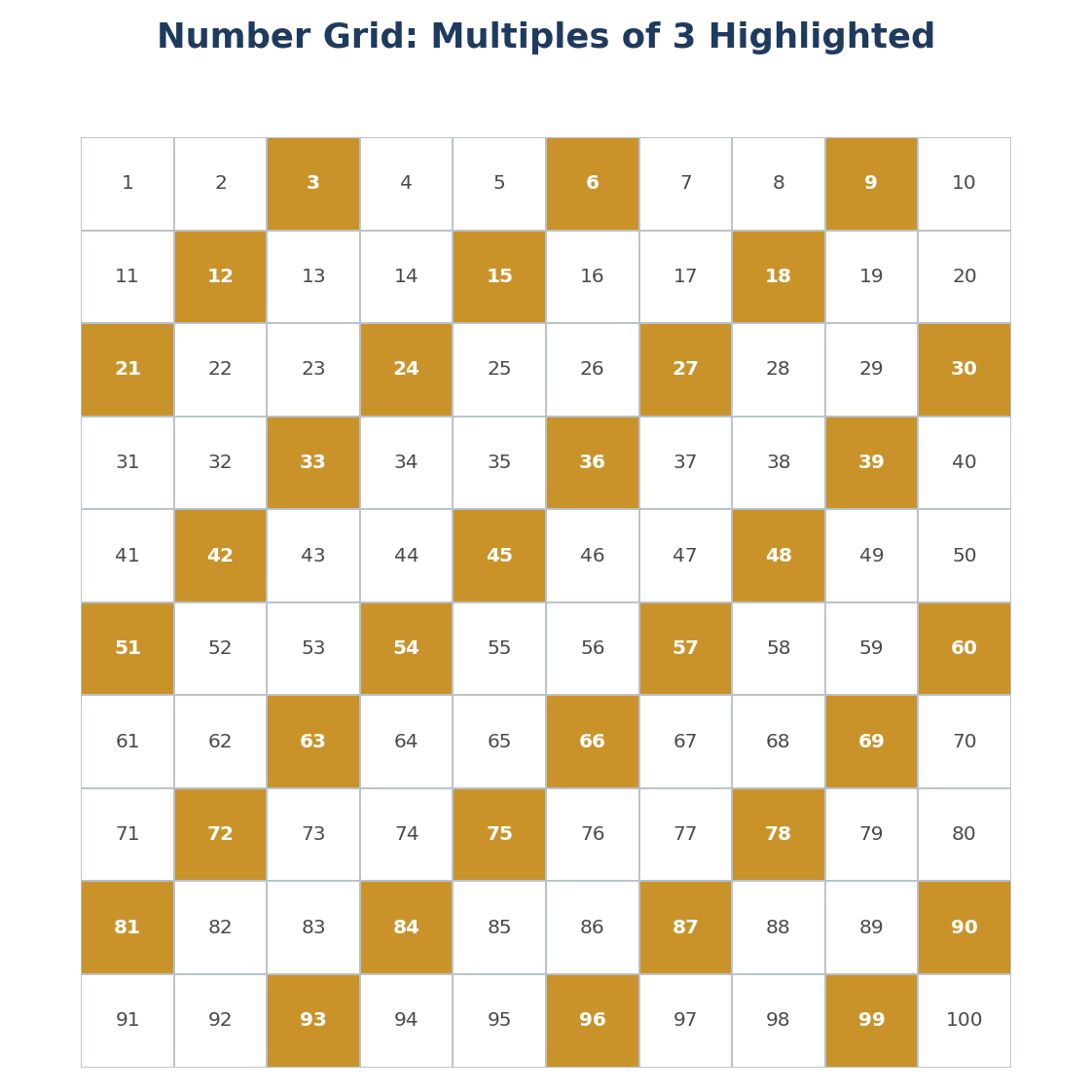
Square 10×10 grid, numbers 1 –100, gold-filled cells for multiples of 3, thin grey gridlines, bold white numerals on shaded cells
Teacher review note
The source text provides all factual content used in this lesson. No additional facts were invented. The two images directly illustrate the grid‑shading discovery and the four pattern families described in the source.
AI-generated learning material based on the uploaded source. Please review explanations, examples and assessments before assigning this lesson to students.