
Lesson 1.3: 1.2 Patterns in Numbers (part 1)
- View
Chapter 1 · Lesson 3 of 8 · About 14 minutes
Learning objectives Extra Practice
- Recognise a pattern in a set of numbers and explain why it is a pattern rather than a coincidence.
- Describe, extend and create number patterns such as skip‑counting, triangular numbers, square numbers and the doubling pattern.
- Discover hidden connections between different number patterns, including the link between triangular and square numbers.
- Represent a pattern using dots, shapes, grids, tables or a simple chart.
- State the general rule behind a pattern in your own words, using both a term‑to‑term rule and a position‑to‑term rule.
- Connect pattern recognition to computational thinking and to how machines learn to spot patterns in data.
Getting started
Patterns are everywhere in mathematics, from the simple act of counting to the elegant structures of triangular and square numbers. In this lesson you will learn to recognise, describe, extend and create several classic number patterns, discover hidden connections between them, and see how the same thinking process underlies computational thinking and artificial intelligence.
Lesson Extra Practice
Counting Patterns and Skip‑Counting
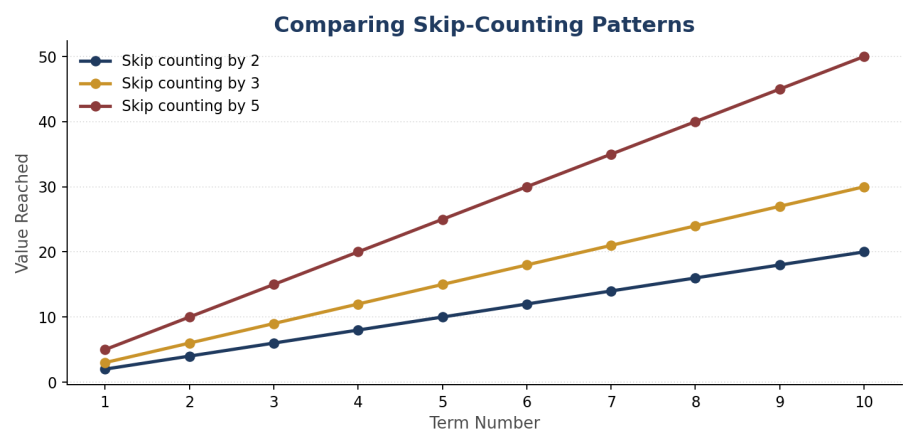
The simplest growing pattern is ordinary counting: 1, 2, 3, 4, 5. A close relative is skip‑counting, where we add a fixed step instead of 1. Skip‑counting by 2 gives 2, 4, 6, 8, 10; by 3 gives 3, 6, 9, 12, 15; by 5 gives 5, 10, 15, 20, 25. These patterns form the foundation for multiplication tables, telling time in five‑minute steps and counting money in coins of a fixed value.
- Step size determines how quickly the sequence grows.
- Larger steps produce steeper growth on a chart.
- Skip‑counting is used in everyday situations such as counting coins, reading clocks and measuring intervals.
- Choose a starting number (usually the step size itself).
- Decide on the fixed step (2, 3, 5, etc.).
- Repeatedly add the step to the previous term to generate the next term.
- Record the terms in a table or plot them on a graph to visualise growth.
| Term | Skip‑count by 2 | Skip‑count by 3 | Skip‑count by 5 |
|---|---|---|---|
| 1 | 2 | 3 | 5 |
| 2 | 4 | 6 | 10 |
| 3 | 6 | 9 | 15 |
| 4 | 8 | 12 | 20 |
| 5 | 10 | 15 | 25 |
Finding the 10th term of skip‑counting by 4 Extra Practice
Problem: What is the 10th term when we skip‑count by 4 starting at 4?
Solution:
- The sequence is 4, 8, 12, 16, …
- Each term = 4 × term number.
- 10th term = 4 × 10 = 40.
Answer: 40
Image prompt 1: section 'Counting Patterns and Skip‑Counting' after the worked example
Generate this image manually, then insert it at this position in the lesson. Suggested file name: ch1-l3-img1.png
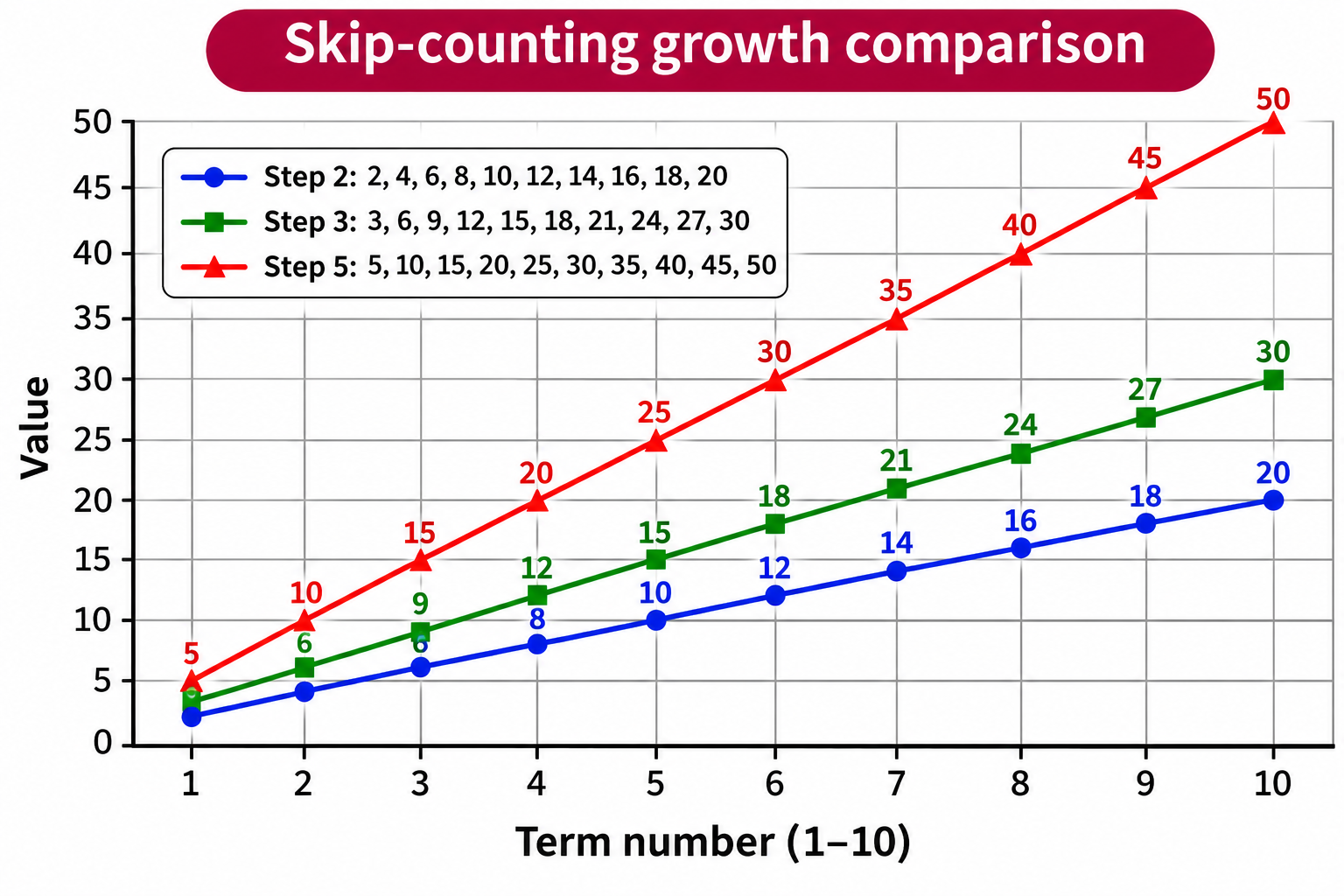
Image insertion point: Add the finished illustration here.
Triangular Numbers
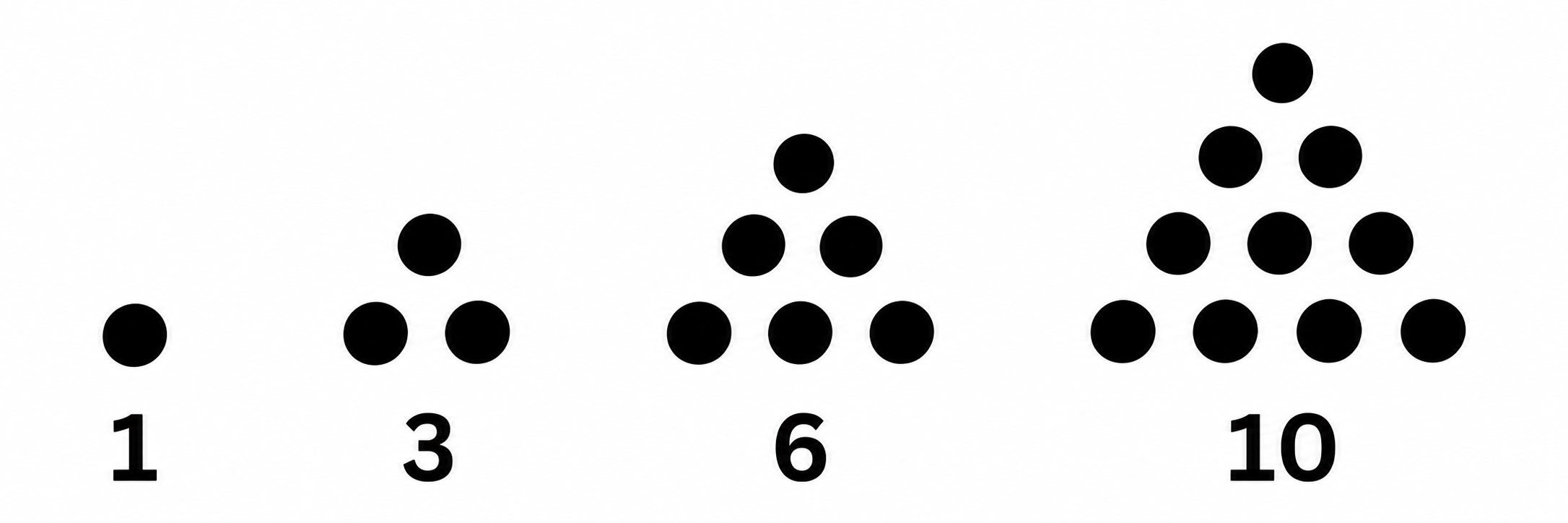
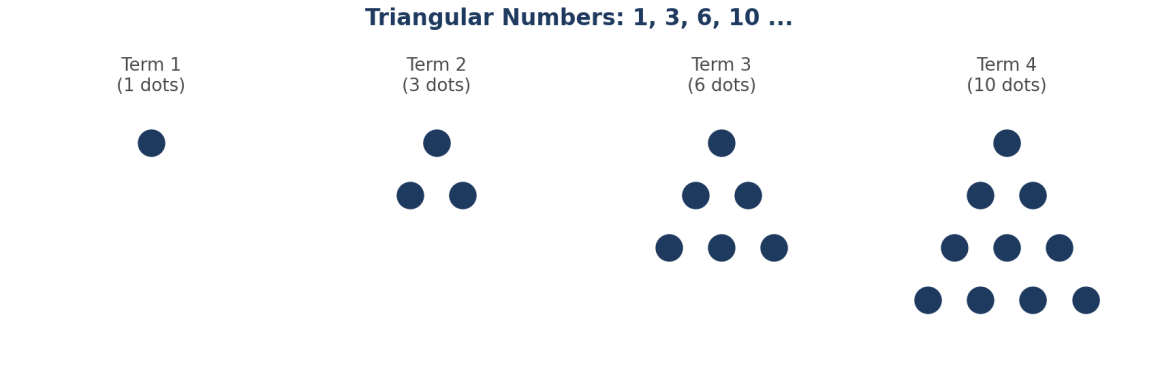
Triangular numbers appear when dots are stacked so each new row has one more dot than the row above. The first term has 1 dot, the second adds a row of 2 dots (total 3), the third adds a row of 3 dots (total 6), and so on. The sequence begins 1, 3, 6, 10, 15, 21.
- Each term adds the next counting number to the previous total.
- Term‑to‑term rule: add one more than you added last time.
- Real‑life examples: handshakes in a growing group, matches in a round‑robin tournament.
- Draw a single dot for term 1.
- Below it, draw a row of 2 dots for term 2.
- Add a row of 3 dots for term 3, continuing the triangle.
- Count all dots to obtain each triangular number.
| Term |
Triangular number | Dots added in this row |
|---|---|---|
| 1 | 1 | 1 |
| 2 | 3 | 2 |
| 3 | 6 | 3 |
| 4 | 10 | 4 |
| 5 | 15 | 5 |
| 6 | 21 | 6 |
Finding the 7th triangular number using the term‑to‑term rule Extra Practice
Problem: Extend the triangular number sequence to the 7th term.
Solution:
- 6th triangular number = 21 (from table).
- Add the next counting number, 7, to 21.
- 21 + 7 = 28.
Answer: 28
Image prompt 2: section 'Triangular Numbers' after the table of triangular numbers
Square Numbers
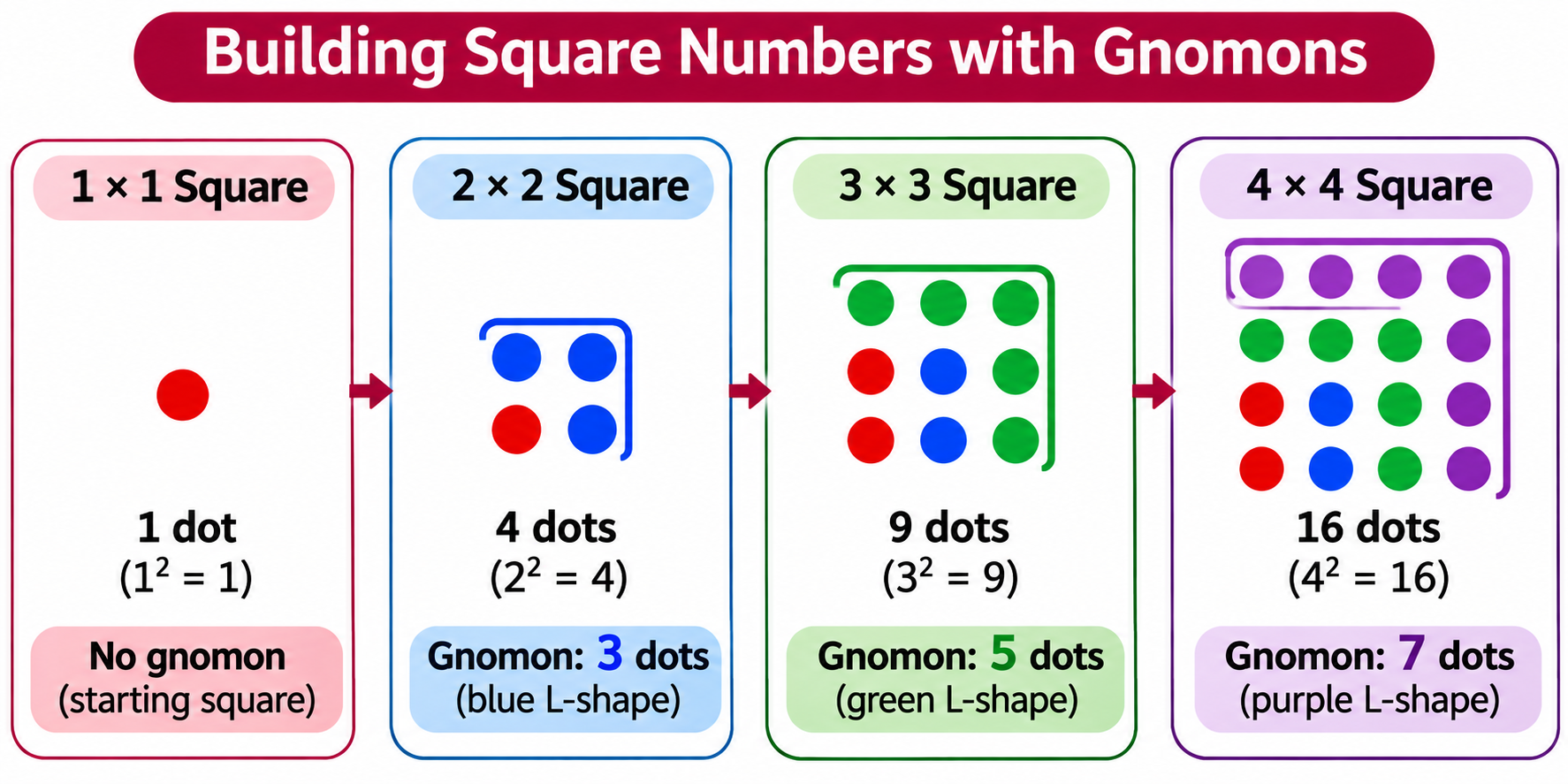
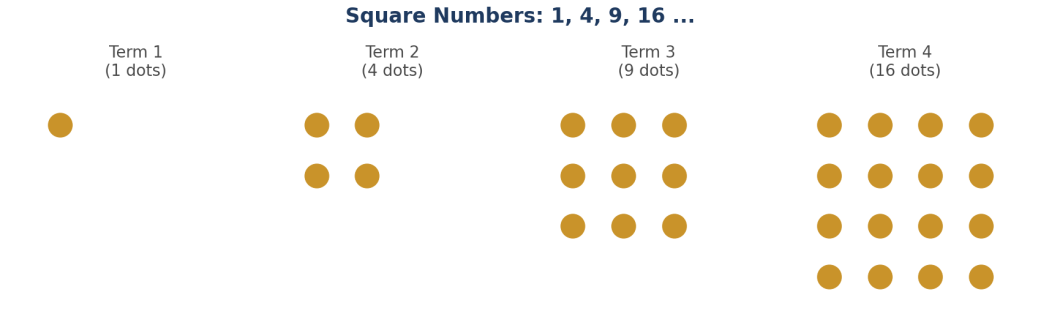
Square numbers are formed by arranging dots into perfect squares: 1×1 (1 dot), 2×2 (4 dots), 3×3 (9 dots), 4×4 (16 dots), 5×5 (25 dots). Each term equals a counting number multiplied by itself. An elegant way to build them is by adding L‑shaped layers called gnomons. The gnomons have sizes 1, 3, 5, 7 … — the odd numbers.
- Each square number is the sum of consecutive odd numbers starting from 1.
- Gnomon sizes follow the odd‑number pattern.
- Square numbers appear in area calculations, tiling and multiplication tables.
- Start with a single dot (1²).
- Add a gnomon of 1 dot to form a 2×2 square (4 dots).
- Add a gnomon of 3 dots to form a 3×3 square (9 dots).
- Continue adding the next odd number of dots for each larger square.
| Square (n²) | Gnomon added (odd number) | Cumulative total |
|---|---|---|
| 1² = 1 | 1 | 1 |
| 2² = 4 | 3 | 1 + 3 = 4 |
| 3² = 9 | 5 | 1 + 3 + 5 = 9 |
| 4² = 16 | 7 | 1 + 3 + 5 + 7 = 16 |
| 5² = 25 | 9 | 1 + 3 + 5 + 7 + 9 = 25 |
Verifying that 5² equals the sum of the first five odd numbers Extra Practice
Problem: Show that 5² = 1 + 3 + 5 + 7 + 9.
Solution:
- List the first five odd numbers: 1, 3, 5, 7, 9.
- Add them: 1 + 3 = 4; 4 + 5 = 9; 9 + 7 = 16; 16 + 9 = 25.
- 25 equals 5².
Answer: 25 = 5²
Image prompt 3: section 'Square Numbers' after the table of square numbers and gnomons
Connections, Rules, and Computational Thinking
Triangular and square numbers are linked: adding two consecutive triangular numbers always gives a square number (e.g., 3 + 6 = 9). The Virahanka (Fibonacci‑style) numbers approach the golden ratio, but that pattern is explored later. For each pattern we can state a term‑to‑term rule (how to get the next term) and a position‑to‑term rule (how to find the nth term directly). The four‑step pattern‑thinking process — Observe, Identify, Predict, Verify — mirrors how computers learn to recognise patterns in data.
- Skip‑counting: term‑to‑term = add the fixed step; position‑to‑term = step × position.
- Triangular numbers: term‑to‑term = add the next counting number; position‑to‑term = sum of the first n counting numbers.
- Square numbers: term‑to‑term = add the next odd number; position‑to‑term = n × n.
- Observe the given terms or visual representation.
- Identify the rule that generates the pattern.
- Predict the next term or the nth term using the rule.
- Verify the prediction by checking against the pattern or by calculation.
| Pattern | Term‑to‑term rule | Position‑to‑term rule (words) |
|---|---|---|
| Skip‑counting (step s) | Add s each time | Multiply step s by the term number |
| Triangular numbers | Add the next counting number | Sum of the first n counting numbers |
| Square numbers | Add the next odd number | Multiply n by itself (n²) |
Writing the position‑to‑term rule for triangular numbers in words Extra Practice
Problem: Express how to find the 8th triangular number without listing all previous terms.
Solution:
- The position‑to‑term rule: add the first 8 counting numbers together.
- 1 + 2 + 3 + 4 + 5 + 6 + 7 + 8 = 36.
Answer: The 8th triangular number is 36.
Teacher–student conversation Extra Practice
Teacher: Look at the skip‑counting chart. What happens to the steepness of the line when the step size increases?
Student: The line gets steeper because each jump is larger.
Teacher: Exactly. That steepness is the growth rate, and it helps us compare patterns even when they follow different rules.
Teacher: Can you explain why adding two consecutive triangular numbers gives a square number?
Student: If you put two triangles together, they form a square. For example, 3 and 6 make 9.
Teacher: Well done. That visual proof shows the hidden connection between the two patterns.
Real-world connections Extra Practice
- Counting coins or notes using skip‑counting by 5, 10 or 20.
- Scheduling recurring events every 3 or 7 days (skip‑counting).
- Designing triangular seating arrangements for a growing audience.
- Calculating floor tiles needed for square rooms using square numbers.
Dot Triangle Building Extra Practice
- Use counters or draw dots on grid paper.
- Build the first five triangular numbers row by row.
- Record the total dots for each triangle in a table.
- Predict the 6th triangular number and verify by building it.
Materials: Counters, grid paper, pencils
Skip‑Counting Chart Race Extra Practice
- In pairs, choose a step size (2, 3, 4, 5).
- Each student writes the first 10 terms on a shared sheet.
- Plot the terms on the same graph paper.
- Discuss which step size produces the steepest line and why.
Materials: Graph paper, coloured pencils, rulers
Important points to remember Extra Practice
- A pattern repeats or grows in a predictable way.
- Skip‑counting adds a fixed step; larger steps give faster growth.
- Triangular numbers add the next counting number each term.
- Square numbers equal n² and can be built by adding consecutive odd numbers (gnomons).
- Two consecutive triangular numbers sum to a square number.
- The four‑step process Observe‑Identify‑Predict‑Verify underlies both human and machine pattern recognition.
Lesson summary Extra Practice
In this lesson you explored three fundamental number patterns — skip‑counting, triangular numbers and square numbers — using dots, tables and charts. You learned to describe each pattern with both a term‑to‑term rule and a position‑to‑term rule, discovered the elegant link between triangular and square numbers, and practiced the four‑step pattern‑thinking process that connects mathematical reasoning to computational thinking.
Illustrations retained from the textbook From Your Textbook
Fig. 1.3: The first four triangular numbers, built by adding one more row of dots each time From Your Textbook
Four-panel dot diagram, terms 1 –4, navy filled circles arranged in a stacked -row triangle, term label and dot-count caption above each panel
Fig. 1.4: The first four square numbers, formed as perfect square arrangements of dots From Your Textbook
Four-panel dot diagram, terms 1 –4, gold filled circles arranged in n×n grids, term label and dot -count caption above each panel
Fig. 1.5: Square numbers rebuilt layer by layer, where each new coloured L -shaped gnomon adds the next odd number of dots From Your Textbook
Four-panel dot diagram, terms 1 –4, each panel shows an n×n square coloured in n bands (one colour per gnomon layer: navy, gold, maroon, green), caption states dots added and running total
Teacher review note
All factual content is drawn directly from the provided source text. No additional information has been invented.
AI-generated learning material based on the uploaded source. Please review explanations, examples and assessments before assigning this lesson to students.