
Lesson 1.6: 1.5 The Pattern-Thinking Process and 1.6 Patterns in Nature and Everyday Technology
- View
Chapter 1 · Lesson 6 of 8 · About 13 minutes
Learning objectives Extra Practice
- Recognise a pattern in numbers, shapes, or events and explain why it is a pattern.
- Describe, extend, and create number patterns such as triangular, square, cube, doubling, and Virahanka numbers.
- Discover connections between different patterns, including Pascal’s Triangle and the golden ratio.
- Represent a pattern using dots, grids, tables, or charts.
- State the general rule using both a term‑to‑term rule and a position‑to‑term rule.
- Connect pattern recognition to computational thinking and how machines learn to spot patterns.
- Identify Virahanka (Fibonacci‑style) numbers in natural spirals such as sunflower seed heads and nautilus shells.
- Describe repeating cycles in everyday technology (traffic lights, washing machines, music).
- Explain how recognising a pattern lets us predict future terms using a term‑to‑term or position‑to‑term rule.
- Connect pattern recognition to the four‑step process: Observe, Identify, Predict, Verify.
- Create a simple observation log of patterns found at home or outdoors.
Getting started
Patterns appear everywhere — from number sequences to the way a computer recognises a cat in a photo. This lesson teaches a reliable four‑step process that mathematicians, scientists, and AI systems use to discover the rule behind any pattern.
Lesson Extra Practice
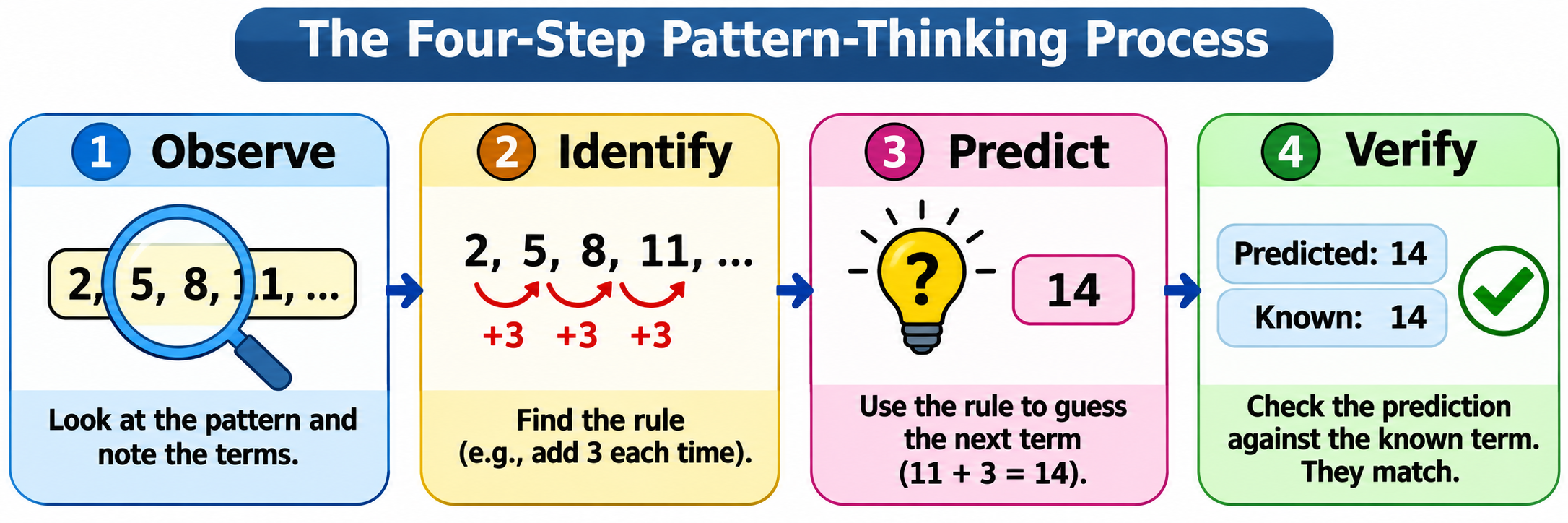
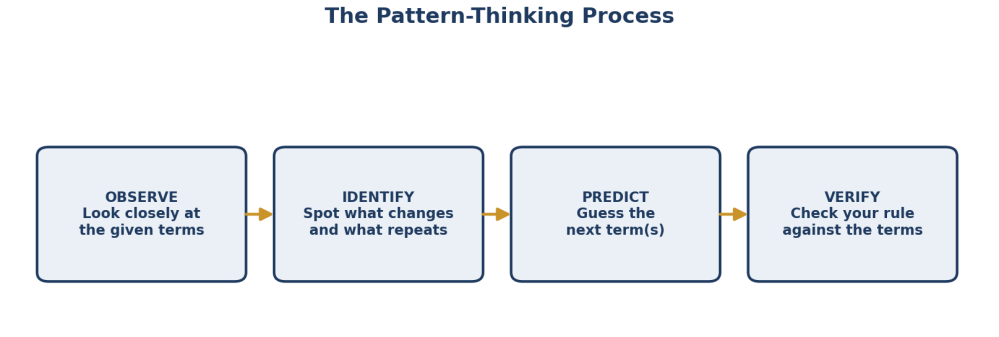
The Four‑Step Pattern‑Thinking Process
Whenever we are given a list of terms and asked to find the rule, experts follow the same four steps. Doing them deliberately makes any pattern problem easier to solve.
- Observe – look at the terms exactly as given, without guessing.
- Identify – find what changes from term to term and what stays the same.
- Predict – use the identified rule to forecast the next term or any later term.
- Verify – check the prediction against a known term so a wrong rule is caught.
Image prompt 1: section/topic where image belongs
Worked Example: 2, 6, 12, 20, 30
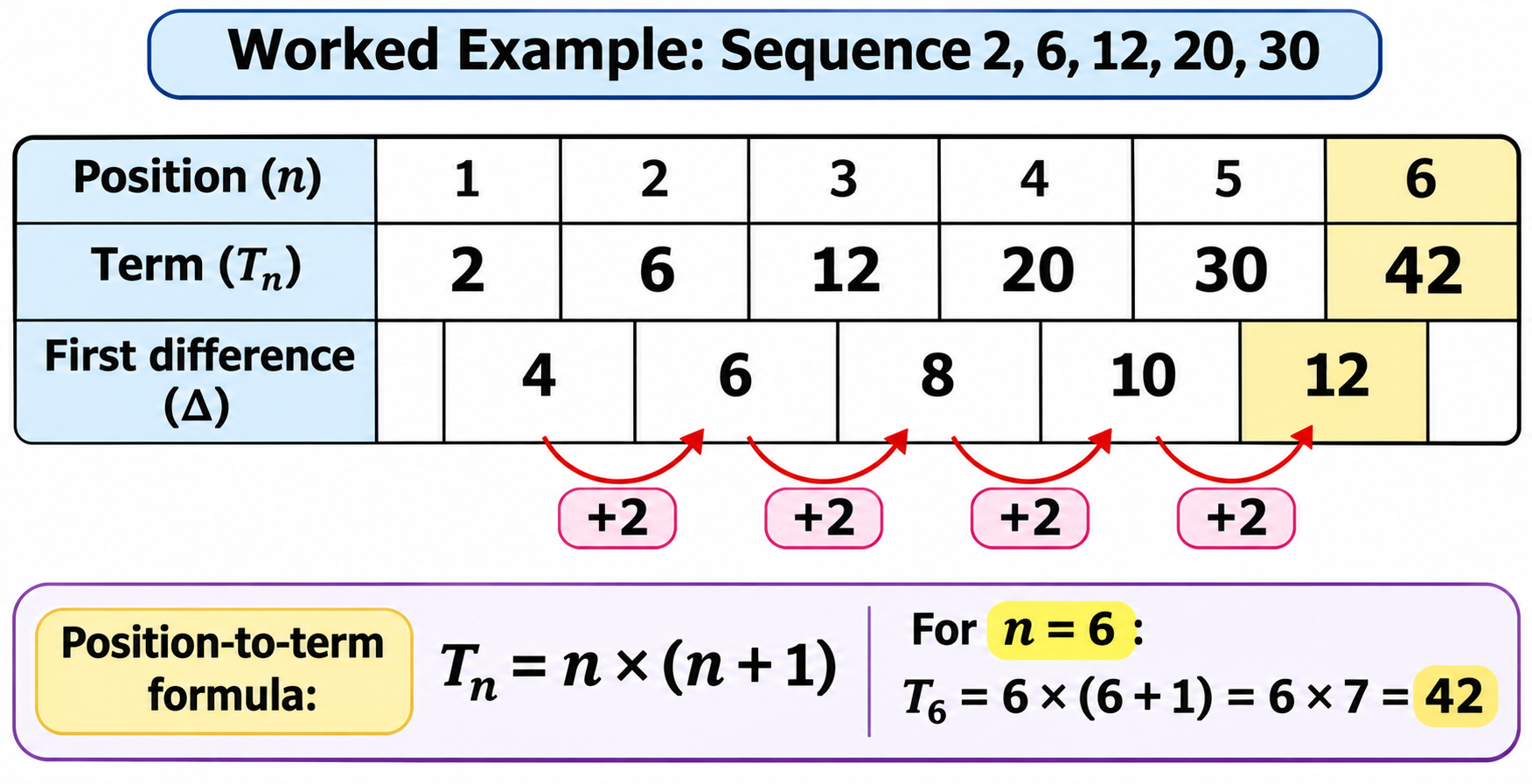
Apply the four steps to the sequence 2, 6, 12, 20, 30.
- Observe: the terms increase, and the amount of increase grows each step.
- Identify: calculate consecutive differences → 4, 6, 8, 10. These differences rise by 2 each time, a second‑level pattern.
- Predict: the next difference should be 12, so the next term = 30 + 12 = 42.
- Verify: find a position‑to‑term rule. Each term equals n × (n + 1). For n = 6, 6 × 7 = 42, matching the prediction.
| Term number |
Term value | Term‑to‑term difference | Position‑to‑term rule n×(n+1) |
|---|---|---|---|
| 1 | 2 | — | 1×2 = 2 |
| 2 | 6 | 4 | 2×3 = 6 |
| 3 | 12 | 6 | 3×4 = 12 |
| 4 | 20 | 8 | 4×5 = 20 |
| 5 | 30 | 10 | 5×6 = 30 |
| 6 (predicted) | 42 | 12 | 6×7 = 42 |
Image prompt 2: section/topic where image belongs
From Patterns to Computational Thinking and AI
The same four steps underlie how computers learn. A voice assistant observes many speech samples, identifies sound patterns that separate words, predicts the meaning of a new sentence, and constantly verifies and corrects its predictions. This cycle is the heart of machine learning and will be explored further in Part 2.
- Observe → collect training data.
- Identify → extract features that distinguish categories.
- Predict → model outputs a label for new input.
- Verify → compare prediction with true label; adjust model.
Practice Activity: Apply the Process
Work in pairs. Each pair receives a different number sequence. Use the four‑step process to find the next two terms and write both the term‑to‑term and position‑to‑term rules.
- Receive your sequence card.
- Observe the terms silently for 30 seconds.
- Identify changes and any sub‑patterns.
- Predict the next two terms.
- Verify by deriving a position‑to‑term formula and testing it on a known term.
- Share your reasoning with the class.
1. Patterns in Nature
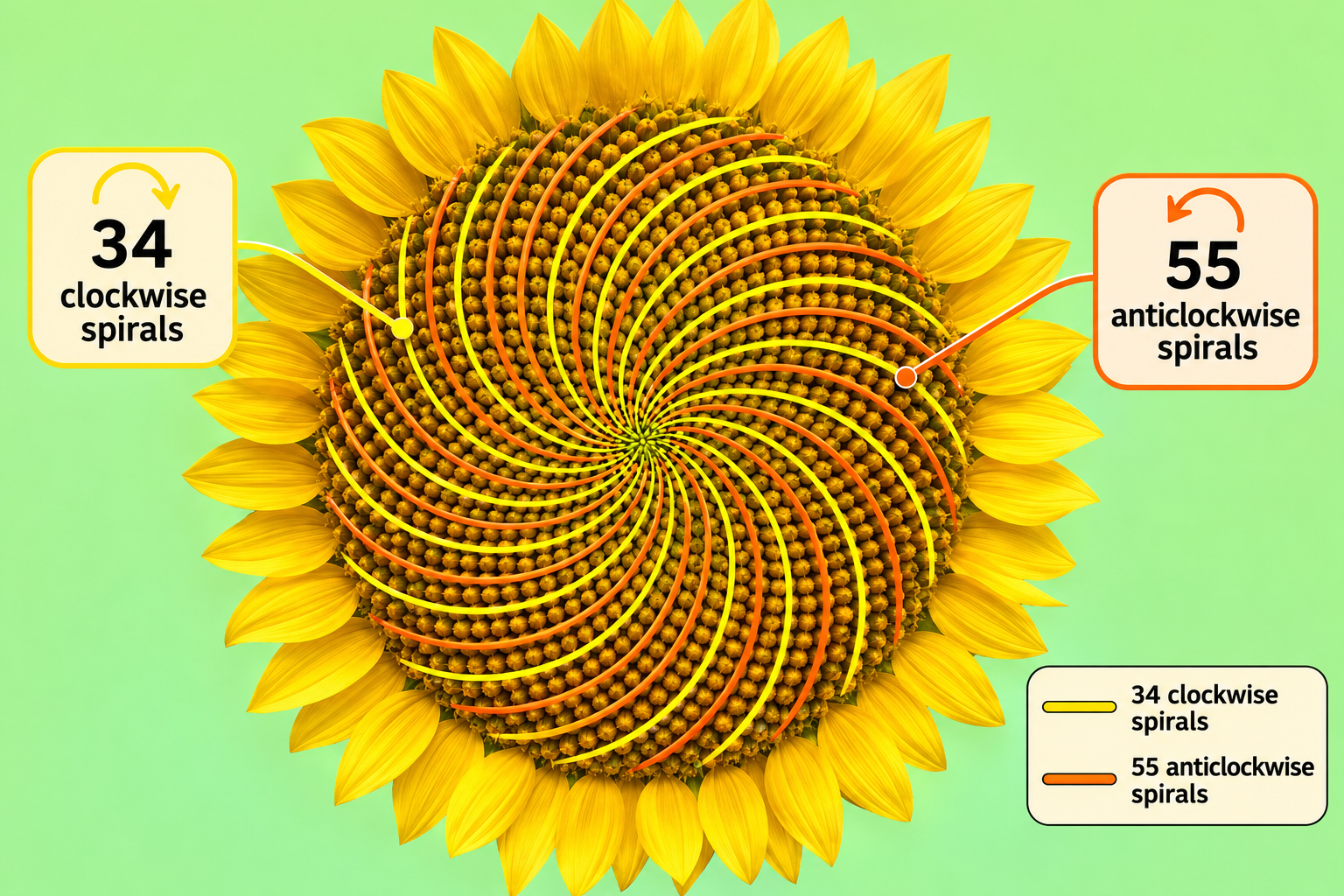
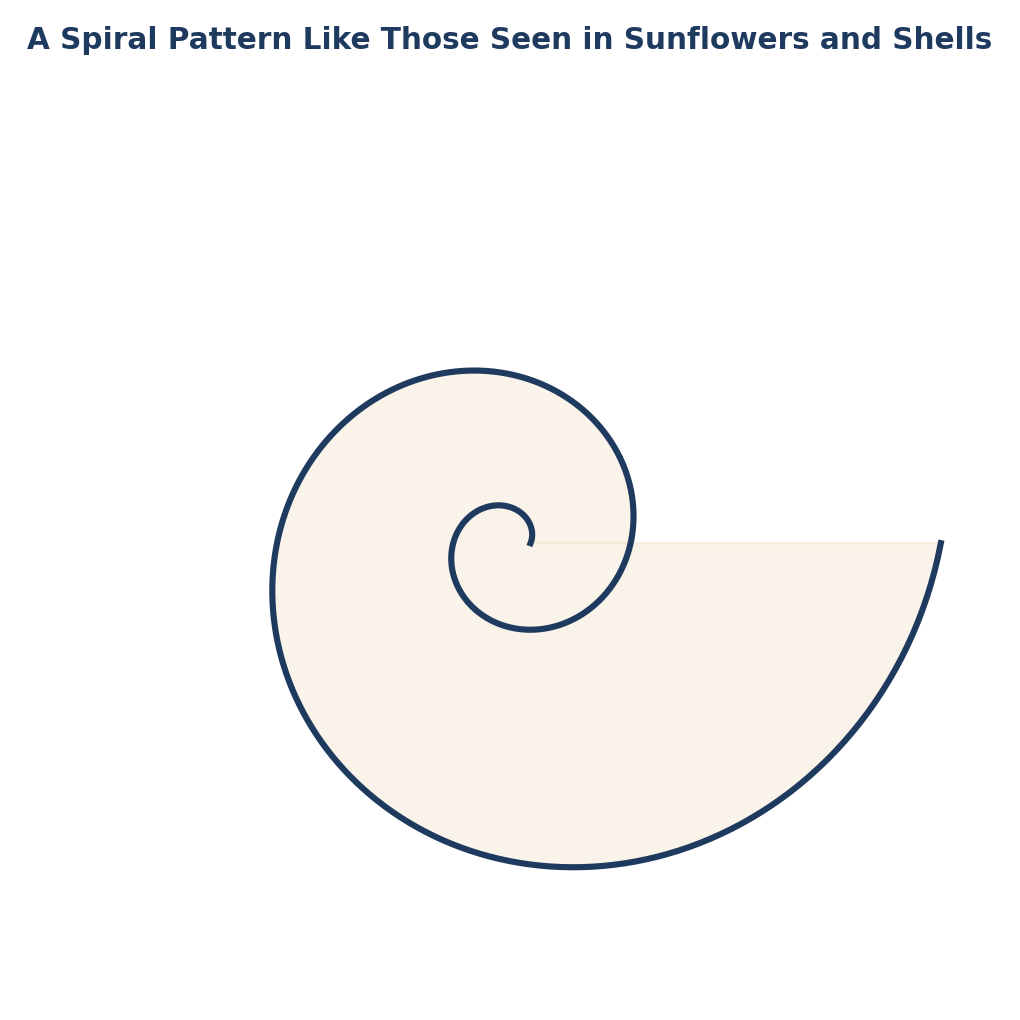
A sunflower packs hundreds of seeds with no wasted space. Each new seed grows at a fixed rotation from the previous one, forming two families of spirals — one clockwise, one anticlockwise. The numbers of spirals are almost always neighbouring Virahanka numbers (e.g., 34 and 55). A nautilus shell shows a similar ever‑widening spiral because each growth ring is a fixed proportion larger than the one before it.
- Sunflower seed head: two spiral families, counts are consecutive Virahanka numbers.
- Nautilus shell: logarithmic spiral, each ring scaled by a constant factor.
- Pinecone: also displays paired spirals with Virahanka counts.
Image prompt 3: Section 1 – Patterns in Nature
| Feature | Sunflower | Nautilus |
|---|---|---|
| Spiral type | Two interlocking families | Single logarithmic curve |
| Number pattern | Neighbouring Virahanka numbers | Constant growth ratio (≈1.618) |
| Purpose | Efficient seed packing | Shell growth without changing shape |
2. Patterns in Everyday Technology
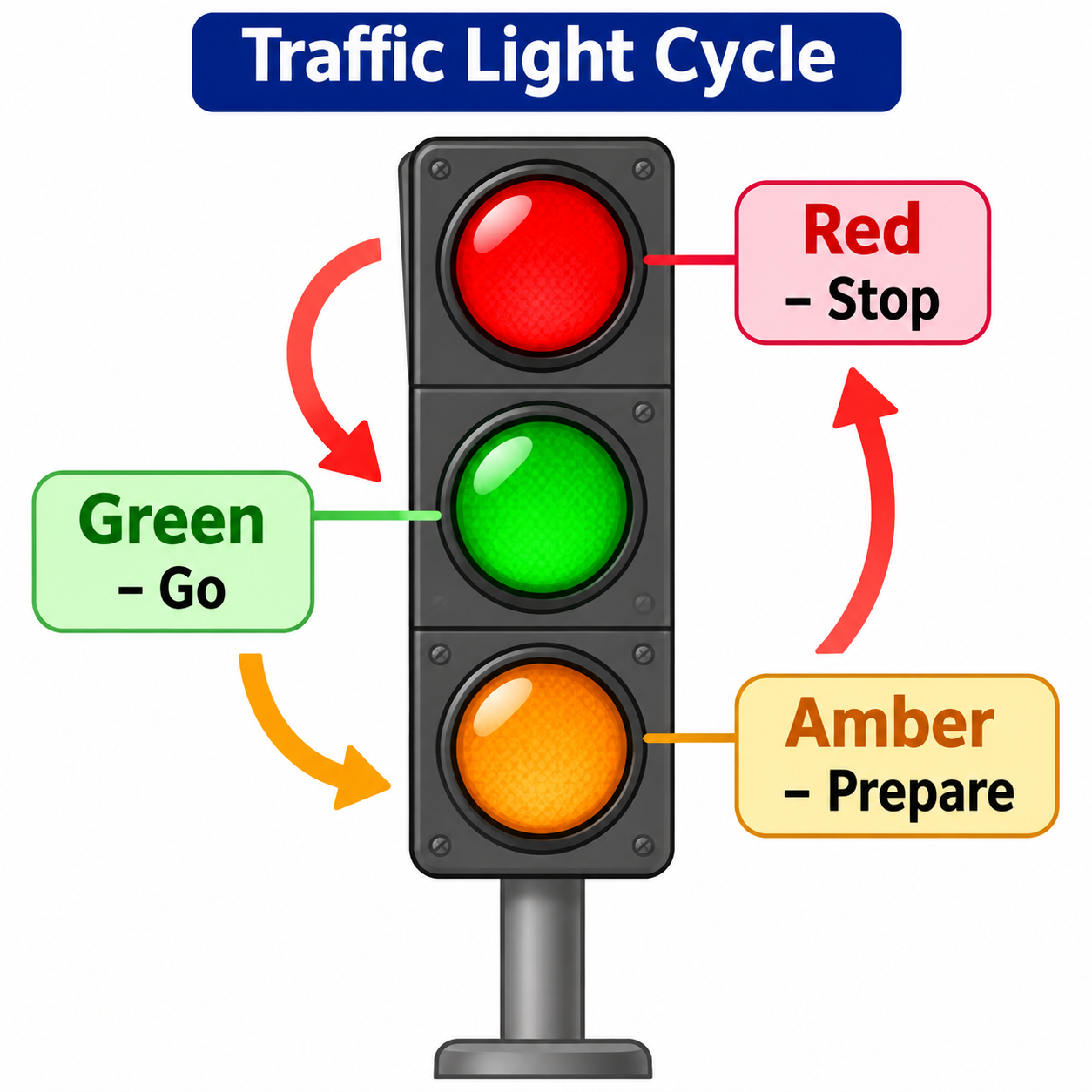
Technology uses deliberately engineered patterns so that people can predict what will happen next. A traffic signal repeats red → green → amber in a fixed order. A washing machine follows the cycle fill → wash → rinse → spin for every load. Music is built from repeating beats and rhythmic patterns that composers choose.
- Traffic light: repeating 3‑state cycle.
- Washing machine: fixed 4‑stage cycle.
- Music: repeating rhythmic units (measures).
- Red – stop
- Green – go
- Amber – prepare to stop
- Cycle repeats
Image prompt 4: Section 2 – Patterns in Everyday Technology
Identify the rule for a traffic‑light cycle Extra Practice
Problem: Write a term‑to‑term rule and a position‑to‑term rule for the sequence Red, Green, Amber, Red, Green, Amber, …
Solution:
- Term‑to‑term: each term is followed by the next colour in the fixed order Red → Green → Amber → Red.
- Position‑to‑term: position 1 = Red, 2 = Green, 3 = Amber; for any position n, compute n mod 3 (1→Red, 2→Green, 0→Amber).
Answer: Term‑to‑term: next colour in the 3‑cycle. Position‑to‑term: colour = {Red if n mod 3 = 1, Green if n mod 3 = 2, Amber if n mod 3 = 0}.
3. From Patterns to Computational Thinking
When we notice that the same handful of patterns — repeating cycles, steady growth, doubling, and sequences built from earlier terms — appear in biology, music, and machines, we are using computational thinking. The four‑step process Observe → Identify → Predict → Verify lets us describe a pattern so a classmate or a computer can extend it without seeing every earlier term.
- Observe: collect data (e.g., count spirals).
- Identify: recognise the underlying rule (Virahanka recurrence).
- Predict: state the next term or the 10th term.
- Verify: check the prediction against the real object or a simulation.
4. Hands‑On Observation Activity
Students will keep a pattern journal for one week, recording at least three patterns they notice in nature or technology.
- Choose a location (garden, kitchen, street).
- Sketch or photograph the pattern.
- Write the observed rule in words (term‑to‑term and position‑to‑term).
- Predict the next two terms or the next cycle.
- Share findings with a partner and verify together.
Teacher–student conversation Extra Practice
Teacher: Let's look at the differences 4, 6, 8, 10. What do you notice about how they change?
Student: They go up by 2 each time.
Teacher: Exactly. That second‑level pattern tells us the next difference will be 12. How does that help us predict the next term?
Teacher: If we write the rule as n × (n + 1), what does n represent?
Student: The position of the term in the sequence.
Teacher: Right. Using that rule for n = 6 gives 42, confirming our prediction.
Teacher: Look at the sunflower picture. How many clockwise spirals do you count?
Student: I count 34 clockwise spirals.
Teacher: Good. Now count the anticlockwise spirals. What do you notice about the two numbers?
Real-world connections Extra Practice
- Traffic‑light timing follows a repeating pattern that engineers optimise.
- Sunflower seed spirals follow Virahanka (Fibonacci) numbers, linking to the golden ratio.
- Recommendation algorithms on streaming services use pattern‑recognition steps to suggest videos.
- Designing efficient packing in agriculture (seed arrangement).
- Programming traffic‑light controllers for safe intersections.
- Creating rhythmic loops in digital music production.
- Training image‑recognition AI to spot spiral patterns in medical scans.
Build a Pattern with Counters Extra Practice
- Place counters to form the first five triangular numbers (1, 3, 6, 10, 15).
- Record each arrangement in a table with term number and total counters.
- Identify the term‑to‑term rule (add the next integer) and the position‑to‑term rule (n(n+1)/2).
- Predict the 6th triangular number and verify by building it.
Materials: Counters or small beads, paper, pencil
Pattern Journal Week Extra Practice
- Each day, find one pattern in nature or technology.
- Draw or photograph it.
- Write the rule in your own words (both term‑to‑term and position‑to‑term).
- Predict the next two steps.
- Bring the journal to class for discussion.
Materials: Notebook, pencil, camera or smartphone (optional), ruler for sketches.
Important points to remember Extra Practice
- The four‑step process — Observe, Identify, Predict, Verify — works for any pattern.
- Differences between terms often reveal a hidden sub‑pattern.
- A position‑to‑term rule lets you jump directly to any term without listing all previous ones.
- The same logical cycle powers computational thinking and AI learning.
- Natural spirals often use neighbouring Virahanka numbers.
- Technology relies on repeating cycles for predictability and safety.
- The Observe‑Identify‑Predict‑Verify cycle is the core of computational thinking.
- A pattern rule can be expressed as a term‑to‑term rule or a position‑to‑term rule.
Lesson summary Extra Practice
By deliberately observing, identifying changes, predicting, and verifying, you can uncover the rule behind any numerical or visual pattern. This method not only solves math problems but also mirrors how computers learn from data, making pattern thinking a foundational skill for both mathematics and modern technology.
Patterns are everywhere — from the seed head of a sunflower to the traffic light on the corner. By learning to spot, describe, and predict these patterns, we develop a powerful way of thinking that underlies mathematics, science, and the algorithms that run modern technology.
Illustrations retained from the textbook From Your Textbook
Fig. 1.13: A schematic spiral of the kind seen in sunflower seed heads, pinecones, and nautilus shells From Your Textbook
Single logarithmic spiral on a polar plot, navy stroke, pale gold fill, no axes or gridlines, centred composition
Figure 1.102: Illustration from the textbook From Your Textbook
Teacher review note
The source provides only one worked example. Teachers may create additional sequences (e.g., square numbers, doubling pattern) for practice. Ensure students articulate both term‑to‑term and position‑to‑term rules during verification. The source text provides all factual content needed for this lesson. No additional information was invented.
AI-generated learning material based on the uploaded source. Please review explanations, examples and assessments before assigning this lesson to students.