
Lesson 1.8: Practical Activity: The Matchstick Tower and Extension Activity: The Golden Ratio Hunt
- View
Chapter 1 · Lesson 8 of 8 · About 10 minutes
Learning objectives Extra Practice
- Recognise the triangular number pattern and explain why it is a pattern.
- Build terms 1‑5 of the pattern with concrete materials.
- Record sticks added and total sticks in a table.
- State the term‑to‑term and position‑to‑term rules in your own words.
- Predict term 6 using the rule, then verify by building.
- Connect the activity to computational thinking: observe, identify, predict, verify.
- Measure the longer and shorter sides of at least five rectangular objects.
- Calculate the side‑length ratio for each object to two decimal places.
- Compare each ratio with the golden ratio (≈1.618) and record which objects are closest.
- Discuss why some objects may have been deliberately designed near this ratio while others match it by chance.
Getting started
In this lesson you will build a growing triangular pattern with matchsticks, record the number of sticks used for each term, discover the rule that generates triangular numbers, and use that rule to predict the next term before checking it by building.
Lesson Extra Practice
What Are Triangular Numbers?
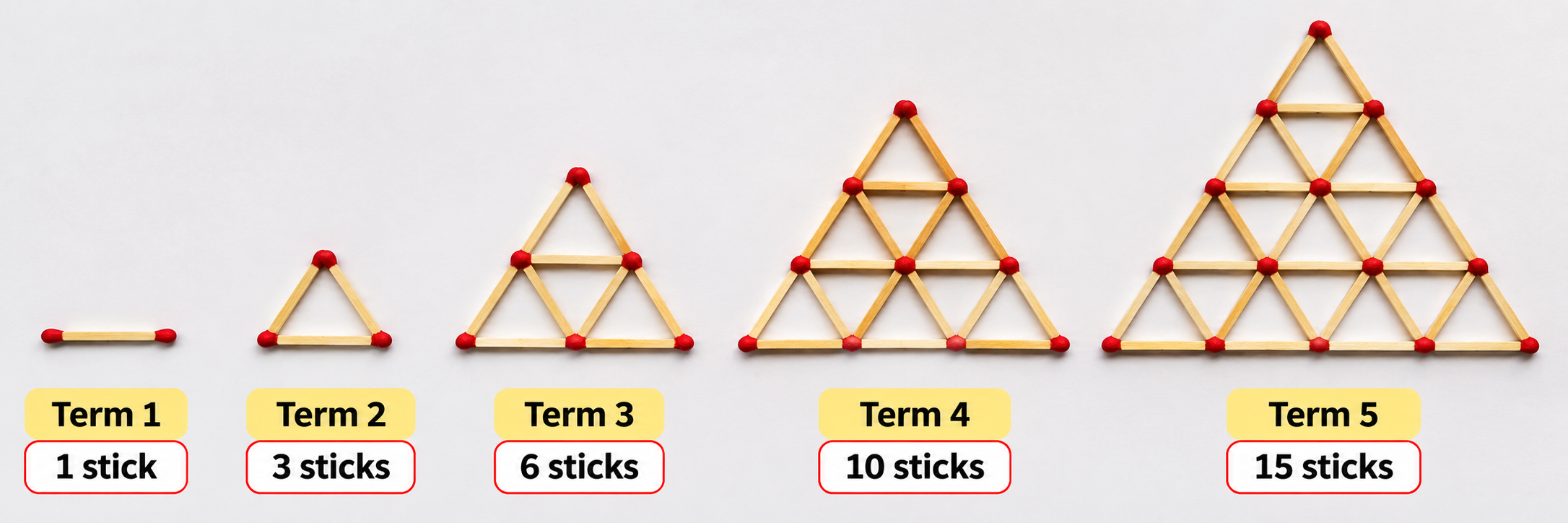
A triangular number is the total number of objects that can form an equilateral triangle. The first triangle has 1 object, the second adds a row of 2 (total 3), the third adds a row of 3 (total 6), and so on. Each new row contains one more object than the previous row.
- Term 1: 1 object
- Term 2: 1 + 2 = 3 objects
- Term 3: 1 + 2 + 3 = 6 objects
- Term 4: 1 + 2 + 3 + 4 = 10 objects
- Term 5: 1 + 2 + 3 + 4 + 5 = 15 objects
Image prompt 1: section/topic where image belongs
Building the Matchstick Tower
Follow the steps below using 40‑50 matchsticks (or ice‑cream sticks or buttons). Work in pairs or small groups.
- Lay out Term 1: a single stick.
- Build Term 2 by adding a row of two sticks beneath the first, forming a small triangle of three sticks.
- Continue building Term 3, Term 4, and Term 5, each time adding a new row that has one more stick than the previous row.
- After each term, count the total sticks used and record the numbers in the observation table.
Image prompt 2: section/topic where image belongs
Recording Observations
Use the table below to record sticks added this term, total sticks so far, and whether the total was verified by counting or predicted.
| Term Number | Sticks Added This Term | Total Sticks So Far | Predicted or Verified? |
|---|---|---|---|
| 1 | 1 | 1 | Verified |
| 2 | 2 | 3 | Verified |
| 3 | 3 | 6 | Verified |
| 4 | 4 | 10 | Verified |
| 5 | 5 | 15 | Verified |
| 6 | — | ? | Predict, then Verify |
Predicting and Verifying Term 6
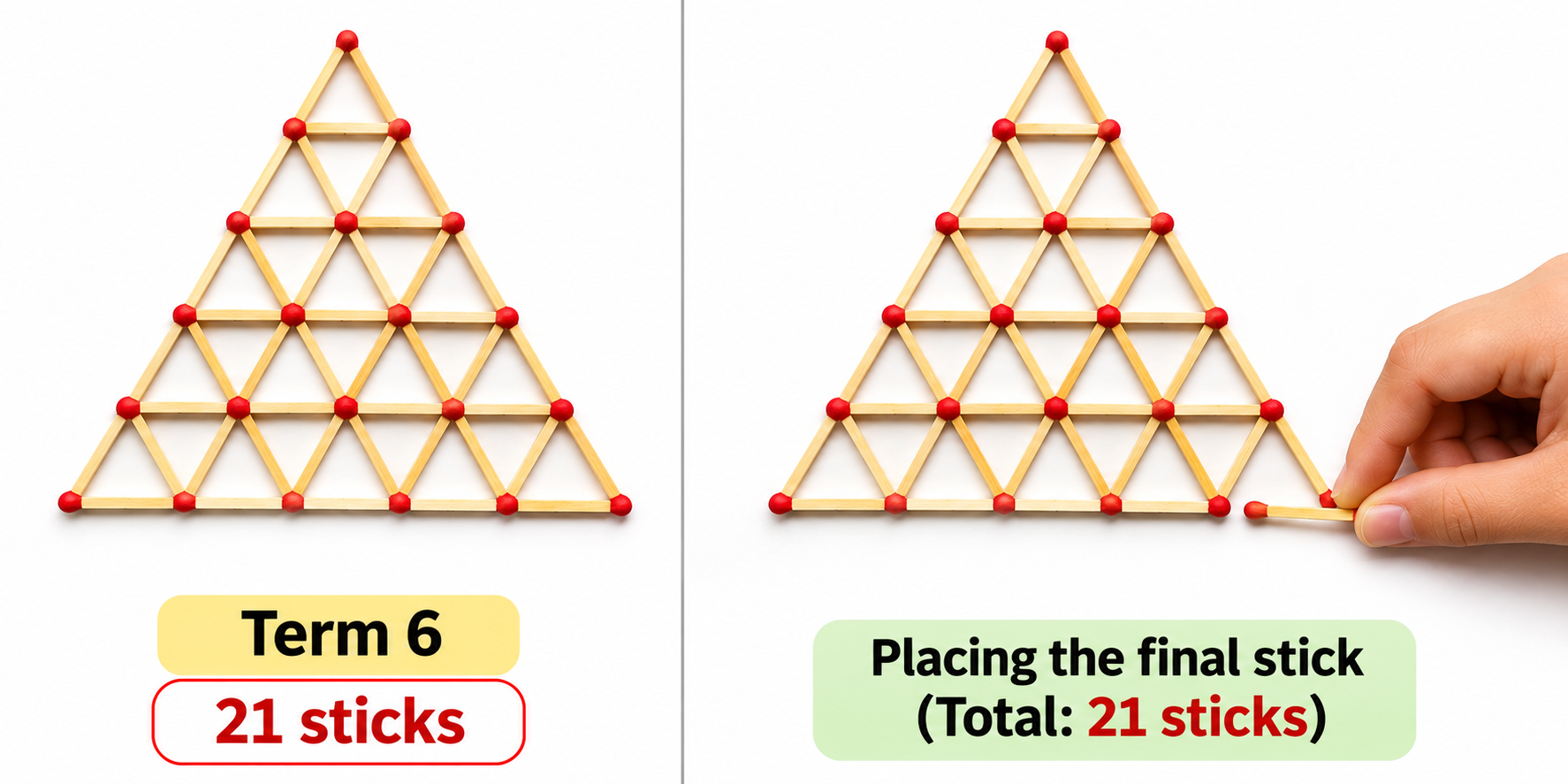
Look at the totals: 1, 3, 6, 10, 15. The term‑to‑term rule is “add the next whole number”. The position‑to‑term rule is “multiply the term number by the next whole number and divide by two”. Use either rule to predict term 6.
Worked Example: Predict Term 6 Extra Practice
Problem: How many matchsticks are needed for Term 6?
Solution:
- Term‑to‑term: previous total 15 + next row size 6 = 21.
- Position‑to‑term: n = 6 → 6 × 7 ÷ 2 = 42 ÷ 2 = 21.
Answer: 21 matchsticks
Now build Term 6 with matchsticks, count the sticks, and compare with your prediction. Record the result in the table as Verified.
Discussion and Connections
Talk with your group: did the prediction match the build? If another group got a different total, find the step where the counts diverged. This mirrors the four‑step pattern‑thinking process used in computational thinking and AI: Observe → Identify → Predict → Verify.
- Triangular numbers appear in bowling pins (10 pins = term 4).
- They model handshake problems: n people each shake hands once → n(n‑1)/2 handshakes.
- They are the sums of the first n natural numbers.
Image prompt 5: Section 'Class Discussion and Connections' after the dialogue
Materials and Preparation
- Ruler or measuring tape (centimetres)
- Calculator or paper for long division
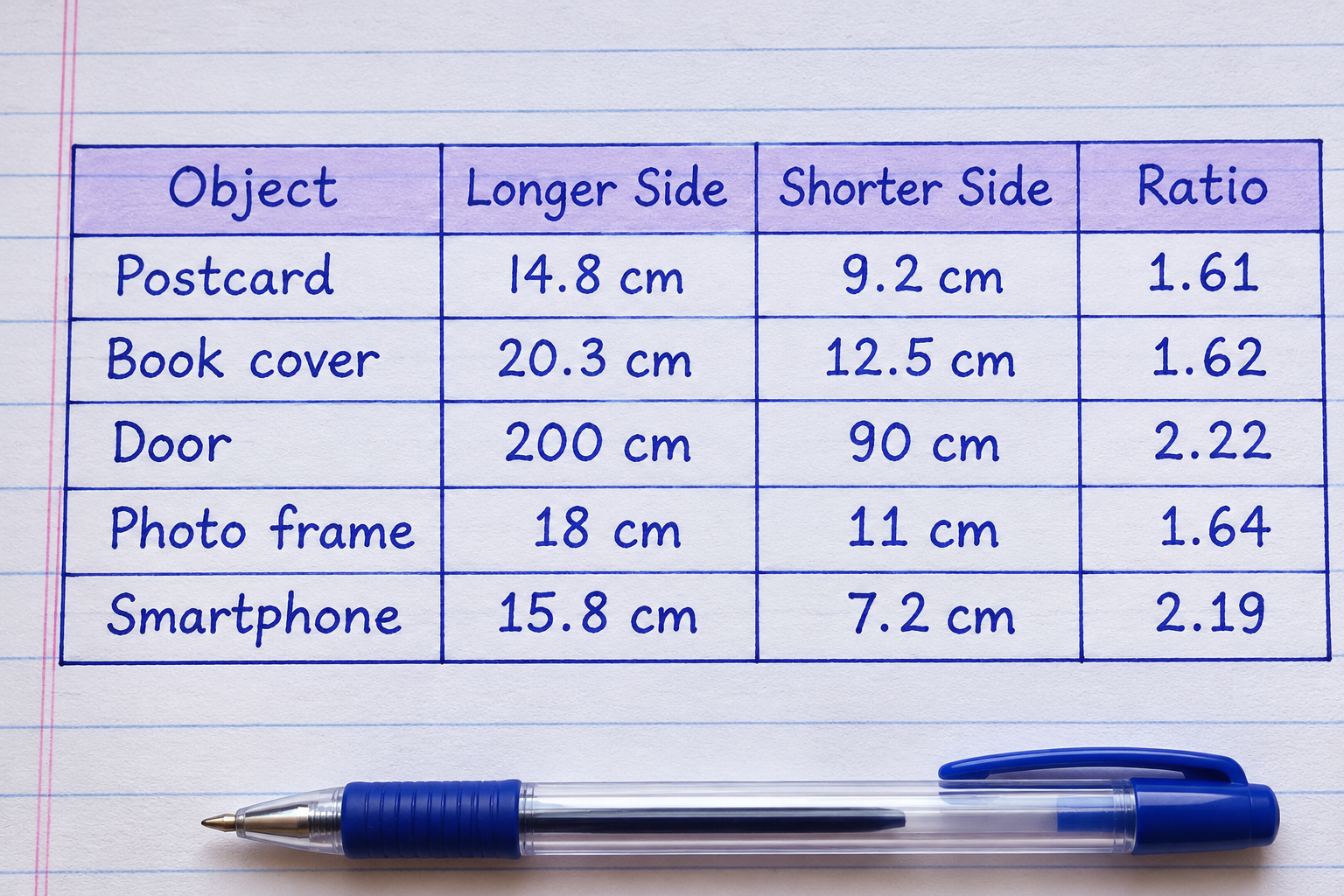
- At least five rectangular objects (e.g., postcard, book cover, door, photo frame, smartphone screen)
Gather the materials before you start. Work on a flat surface so measurements are accurate.
Step‑by‑Step Procedure
- Choose a rectangular object and measure its longer side (L) and shorter side (S) in centimetres.
- Divide L by S using a calculator. Round the result to two decimal places.
- Record the object name, L, S, and the ratio in a table (see next section).
- Repeat steps 1‑3 for at least four more objects.
- As a class, combine all tables into one master chart and compare each ratio to 1.618.
Worked Example – Measuring a Book Extra Practice
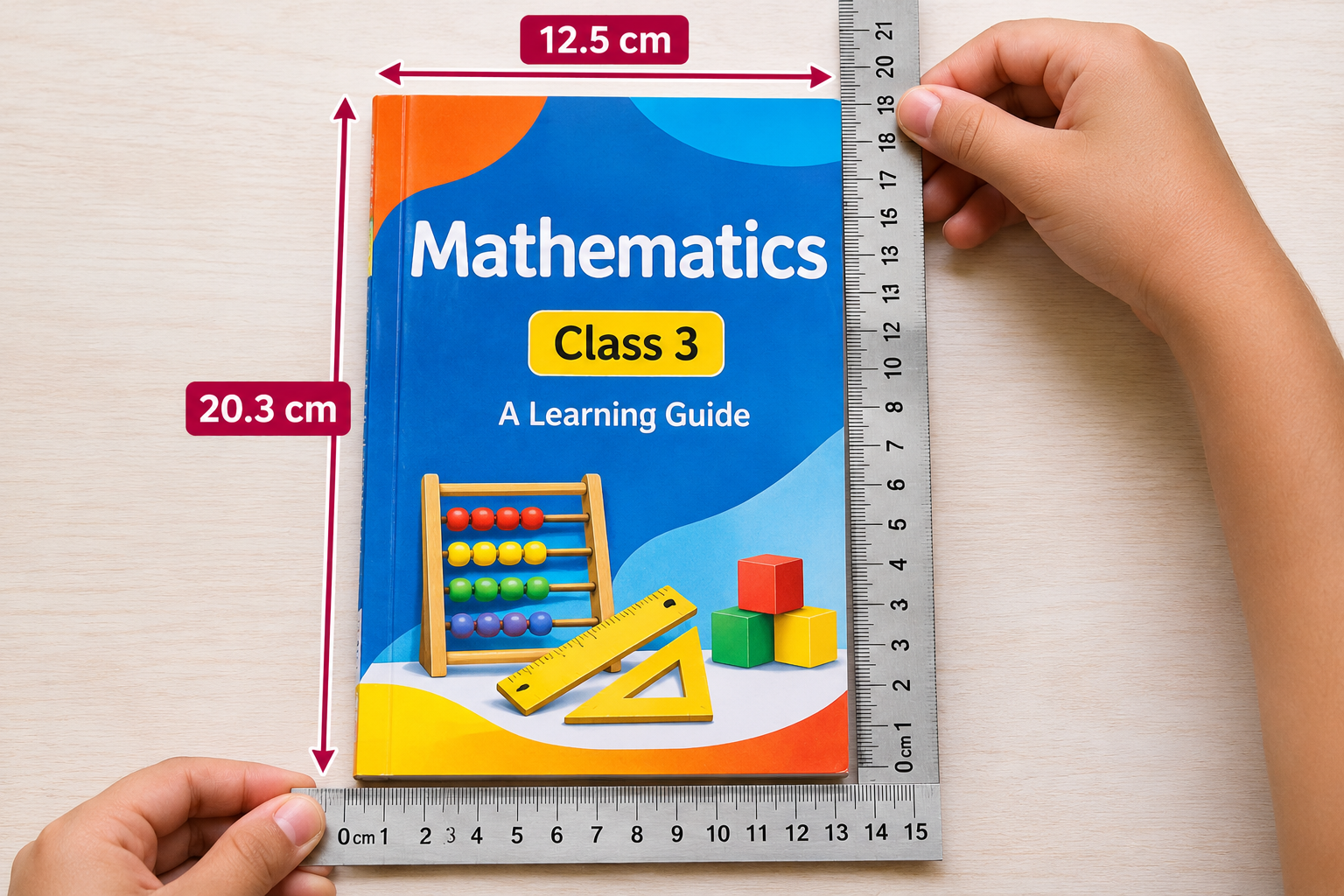
Problem: A paperback book measures 20.3 cm (longer side) by 12.5 cm (shorter side). Find the ratio and compare it to the golden ratio.
Solution:
- Divide 20.3 by 12.5 → 1.624
- Round to two decimal places → 1.62
- Difference from 1.618 = 0.002 (very close)
Answer: The book’s ratio is 1.62, only 0.002 away from the golden ratio.
Image prompt 3: Section 'Step‑by‑Step Procedure' after the worked example
Recording Results – Data Table
Use the table below as a template. Fill in one row per object.
| Object | Longer Side (cm) | Shorter Side (cm) | Ratio (L÷S) |
|---|---|---|---|
| Postcard | |||
| Book cover | |||
| Door | |||
| Photo frame | |||
| Smartphone screen |
Image prompt 4: Section 'Recording Results – Data Table' after the table
Class Discussion and Connections
- Identify which objects have ratios closest to 1.618.
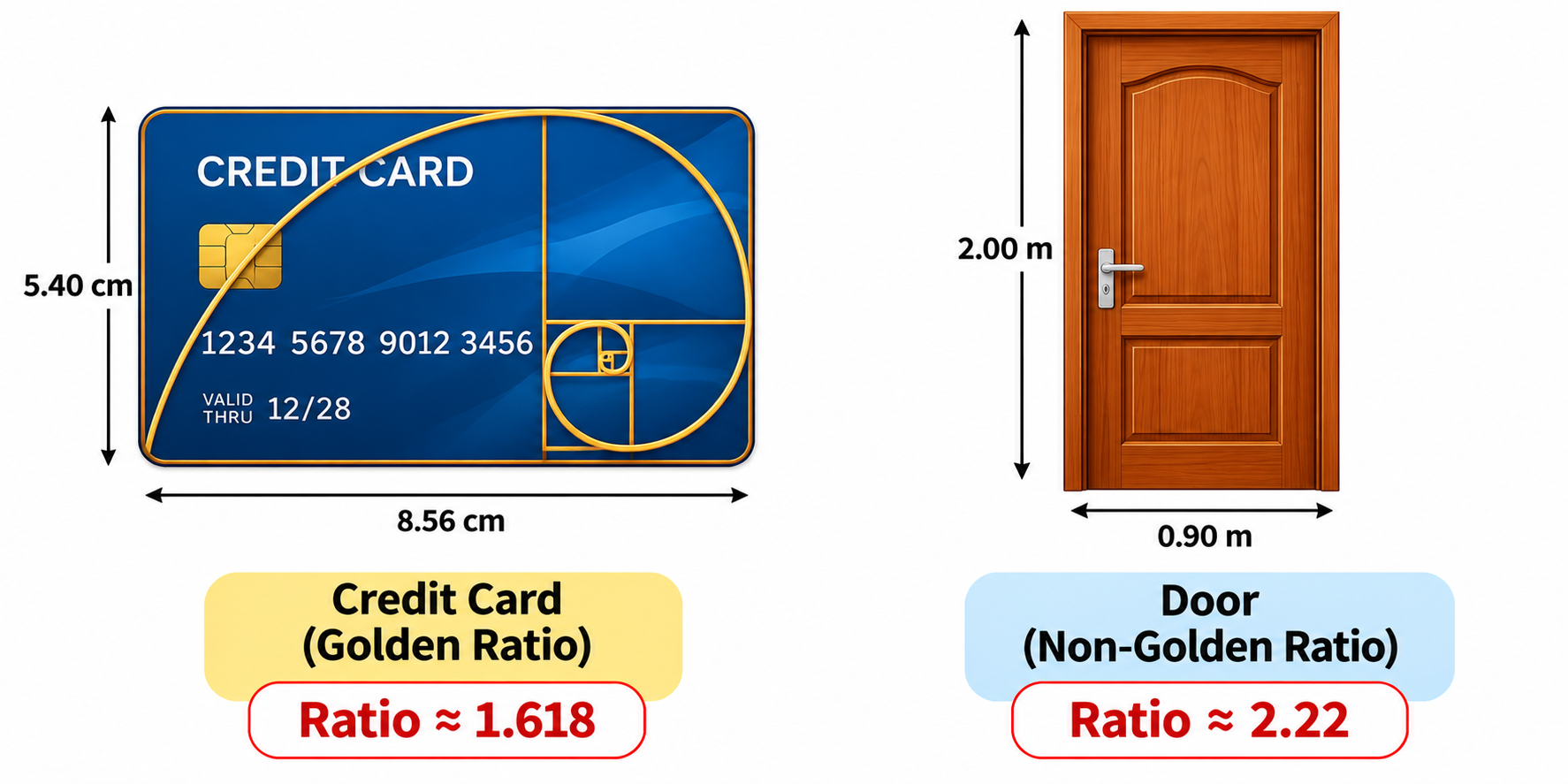
- Consider whether the object was likely designed with the golden ratio in mind (e.g., standard photo frames, credit cards) or if the closeness is coincidental.
- Link the activity to the Verify step of the pattern‑thinking process: you observed a pattern (golden ratio), predicted it might appear in rectangles, measured to test the prediction, and now verify the result.
Teacher–student conversation Extra Practice
Teacher: What pattern do you notice in the totals 1, 3, 6, 10, 15?
Student: Each total adds the next whole number: +2, +3, +4, +5.
Teacher: Exactly. Can you write a rule that gives the total for any term number n?
Teacher: If we want term 10 without building, what would you do?
Student: Use the formula n(n+1)/2. For n=10 that's 10×11/2 = 55.
Teacher: Well done. That formula is the position‑to‑term rule.
Teacher: Why do you think many picture frames are close to 1.618?
Student: Maybe because that shape looks balanced to our eyes?
Teacher: Exactly — designers often use the golden ratio because many people find those proportions pleasing. But not every rectangle follows it; a door is usually taller for practical reasons.
Real-world connections Extra Practice
- Arranging seats in a triangular auditorium section.
- Calculating total handshakes in a meeting.
- Designing triangular stacking of cans or boxes.
- Architecture and product design often use the golden ratio for aesthetic appeal.
- Graphic designers apply it to layout grids and logo proportions.
- Nature shows the ratio in spiral shells, sunflower seed heads, and galaxy arms.
Group Matchstick Tower Extra Practice
- Each group builds terms 1‑5, fills the observation table, predicts term 6, builds term 6, and verifies.
- Groups compare results and discuss any discrepancies.
Materials: 40‑50 matchsticks (or ice‑cream sticks/buttons) per group, ruled notebook page.
Home Extension: Dot Triangles Extra Practice
- Draw triangular dot patterns for terms 1‑8 on graph paper.
- Write the term‑to‑term and position‑to‑term rules in your own words.
- Find two real‑world examples of triangular numbers and bring them to class.
Materials: Graph paper, pencil, ruler.
Golden Ratio Hunt (Home or Classroom) Extra Practice
- Collect five rectangular objects.
- Measure and record each as described in the procedure.
- Calculate ratios and note the three objects closest to 1.618.
- Bring your table to class for the combined chart and discussion.
Materials: Ruler or measuring tape, calculator, five rectangular objects, printed recording table.
Important points to remember Extra Practice
- Triangular numbers grow by adding consecutive whole numbers.
- Term‑to‑term rule: add the next integer.
- Position‑to‑term rule: total = n(n+1)/2.
- The four‑step pattern process (Observe, Identify, Predict, Verify) is the basis of computational thinking.
- Concrete building helps visualise abstract number patterns.
- The golden ratio ≈ 1.618.
- Ratio = longer side ÷ shorter side.
- Measuring real objects lets you verify a mathematical pattern.
- Some objects are deliberately designed near the ratio; others match by chance.
Lesson summary Extra Practice
You built a physical triangular pattern, recorded the growing totals, discovered both the term‑to‑term and position‑to‑term rules, used the rule to predict term 6, and verified the prediction by building. This hands‑on experience shows how patterns can be observed, described, extended, and checked — skills that underlie mathematics, computer science, and everyday problem solving.
By measuring everyday rectangles you experience the full pattern‑thinking cycle: observe the golden ratio, predict its presence, measure to test, and verify the results. The activity shows how a simple number pattern connects to design, nature, and the way we evaluate mathematical ideas against real data.
Teacher review note
The source provides the complete procedure, observation table, and discussion prompt. No additional facts are needed. Ensure students have enough matchsticks for Term 6 (21 sticks) before the verification step. The source provides the complete activity description. No additional facts were invented. Ensure students use centimetres consistently and round to two decimal places. The class chart can be created on a whiteboard or spreadsheet.
AI-generated learning material based on the uploaded source. Please review explanations, examples and assessments before assigning this lesson to students.