1.1 What Is a Pattern?
A pattern is an arrangement of numbers, shapes, colours, or events that follows a rule, so that once you know the rule, you can say with confidence what comes next. The key word here is rule. A pattern is not simply “something repeated” — it is something repeated or changed in a predictable way. Consider the sequence of numbers 5, 10, 15, 20. Even without being told, most of us can sense that the next number should be 25, because each term is 5 more than the one before it. That sense of “knowing what comes next” is exactly what makes something a pattern rather than a random jumble of digits.
Patterns generally fall into a few broad families, and it helps to know their names, because mathematicians and computer scientists use this vocabulary constantly:
- Repeating patterns, where a fixed group of items appears again and again, such as red-blue-red-blue-red-blue.
- Growing patterns, where each term is larger than the one before, following a fixed rule, such as 2, 4, 6, 8.
- Shrinking patterns, where each term becomes smaller according to a rule, such as 100, 90, 80, 70.
- Shape or visual patterns, where the rule governs how a picture, tile, or arrangement changes from one step to the next.
Notice that a pattern always has two parts that work together: the terms, which are the actual numbers or shapes you can see, and the rule, which is the hidden logic connecting one term to the next. Mathematicians spend a great deal of time trying to uncover the rule behind a set of terms, because once the rule is known, the entire pattern — however long — becomes completely predictable. A useful first habit is to look for structure using a grid, since a grid often makes a hidden pattern leap out at you visually in a way that a plain list of numbers does not.
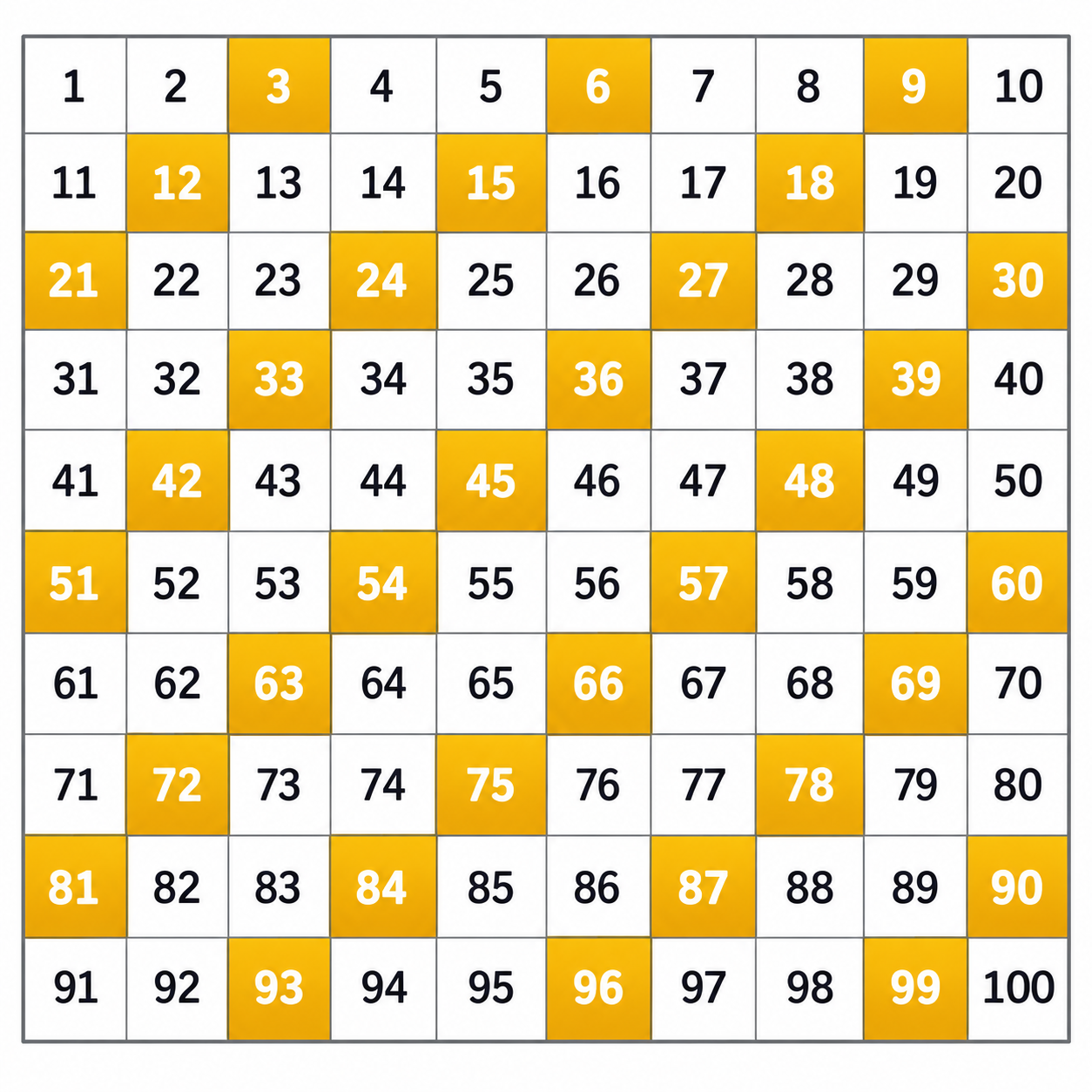
Consider the grid of the first hundred counting numbers below, with every multiple of 3 shaded. Even though the shaded numbers are scattered across ten separate rows, notice how they line up into clean diagonal stripes running across the grid. This diagonal striping is not an accident — it happens because each row of the grid is exactly 10 numbers wide, and 10 is not a multiple of 3, so every time the shading “wraps around” to a new row, it lands one position further to the left. This is a small but genuine discovery: a rule about grid width (10) interacting with a rule about multiples (3) produces a completely new, second-order pattern that neither rule shows on its own.
|
IMAGE · FIG 1.1 [ref: fig-1-1]
FIG 1.1 — A 10×10 number grid with every multiple of 3 shaded, showing the diagonal striping this produces. Image Spec: Square 10×10 grid, numbers 1–100, gold-filled cells for multiples of 3, thin grey gridlines, bold white numerals on shaded cells. |
|